Industry related headlines to keep you in the know.
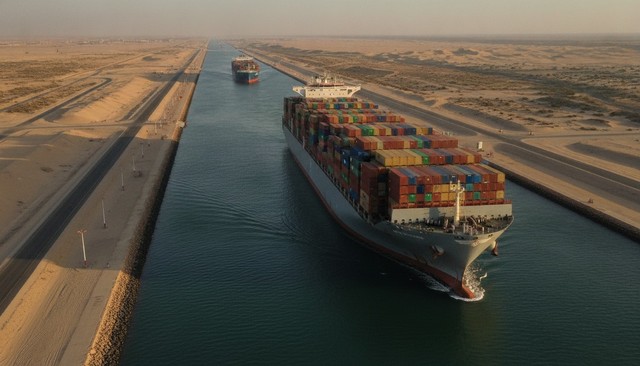
COSCO SHIPPING Lines put its first southbound containership through the Suez Canal since the Red Sea crisis began when the 24 188 TEU OOCL Portugal transited on 16 September 2026, and container tonnage through the canal is now running 54.2% ahead of last year. The Cape of Good Hope diversion that has shaped Southern Africa's shipping horizon for nearly three years is unwinding faster than most SADC operators have priced in.
Shipping and Logistics
18 September 2026 • 4 min read
The Suez Canal Authority says container ship net tonnage through the canal reached 72.1 million tons in the first eight months of 2026, up 54.2% on the same period last year. Maersk and Hapag-Lloyd have just moved four more Gemini services off the Cape route. For SADC operators the question is no longer whether the diversion ends, but what the Cape traffic tail leaves behind when it goes.
The nearly 400-metre OOCL Portugal was on a voyage from Belgium to China when it entered the canal on Wednesday, operating on the Ocean Alliance NEU2 service between the Far East and North West Europe. The Suez Canal Authority described it as COSCO SHIPPING Lines' first southbound passage through the waterway since the security crisis began. On the same day, 39 ships carrying a combined 2.3 million net tons transited the canal.
That matters because COSCO's return completes the set. The canal authority says services operated by CMA CGM, Maersk, MSC, Hapag-Lloyd and COSCO have all come back to varying degrees. Until this week, the Cape route could still be described as the default for at least one of the world's three container alliances. It no longer can.
Suez container tonnage: 72.1 million net tons of container shipping transited the Suez Canal in the first eight months of 2026, up 54.2% from 46.7 million tons in the same period of 2025. (Source: Suez Canal Authority via gCaptain, 2026)
Maersk and Hapag-Lloyd announced on Monday that four more Gemini Cooperation services, AE5, AE11, AE12 and ME2, will shift from the Cape of Good Hope back to Suez. They join AE15 and AE19, already running through the canal. Routing via Suez strips thousands of miles off an Asia to Europe voyage, which cuts transit time, fuel burn and the number of vessels needed to hold a weekly service together.
The security picture is moving the other way. Houthi forces have taken Mocha and positions on islands around the Bab el-Mandeb Strait this month, the southern gate every Suez-bound ship must pass. The group has so far confined its declared naval blockade to Saudi vessels and reportedly told US officials in Oman it will not target American or Israeli ships. Both carriers said explicitly that future routing depends on continued stability, and Maersk restated that crew, vessel and cargo safety comes first. In plain terms, these services can go back around the Cape at short notice.
Very little of the Cape diversion ever landed as revenue in Southern African ports. The overwhelming majority of diverted vessels transited past South Africa and Namibia rather than calling, so the rerouting was mostly a story about ships on the horizon. What the unwind does change is schedule behaviour. Carriers switching a service between Suez and the Cape reset transit times, port rotations and cut-off dates, and a service that has swapped twice in a quarter is a service whose arrival date you cannot plan a factory or a packhouse around.
The second effect is capacity. Shorter voyages free up vessels, and released tonnage has historically cascaded down onto secondary trades, Africa among them. That can mean more slots and softer rates on SADC lanes, or it can mean bigger ships calling at berths that were not designed for them. Either way, the operators who get hurt are the ones still quoting off a 2025 transit assumption.
Ask your forwarder, in writing, which of your services are routed via Suez this month and which are still going around the Cape, and get the current transit time for each. Rebuild inland collection and delivery schedules off those numbers rather than last year's. And because carriers have said the routing is conditional, keep a Cape-route transit time on file as the contingency case instead of assuming the shorter voyage is now permanent.
Stay connected with Southern Africa's freight and transport community.
Join 6,400+ logistics professionals across the SADC region.
Visit Laaimylorrie.com| About the Author | |

|
Andre Klynsmith Entrepreneur & Technology Enthusiast Andre's expertise spans technology, blockchain, transport, and logistics -- with a passion for innovation and driving positive change across industries. |
| Source: gCaptain View source › | 16 September 2026 |


Subscribe to our Newsletter and stay in the know with all the latest Industry News, Products and Trends covering the whole of the SADC region.
KS Blockchain T/A Laaimylorrie.com . All Rights Reserved.