Industry related headlines to keep you in the know.
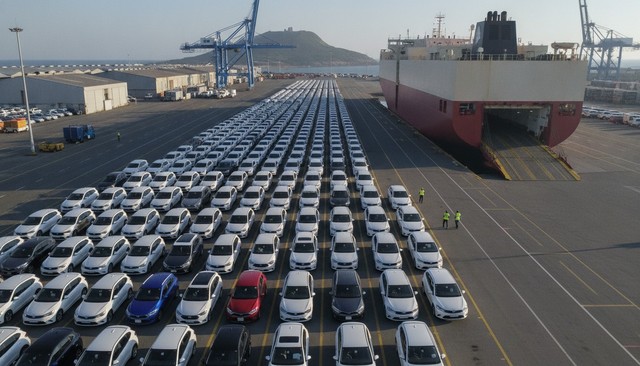
Roughly three out of every four vehicles exported from South Africa are destined for Europe, and up to R291 billion in export revenue could be at risk if the country does not align with the European Union's new vehicle circularity regime. For ro-ro operators, port terminals and the inland transporters feeding them, that is not a distant regulatory story -- it is the single largest concentration of export freight in the country.
SHIPPING AND LOGISTICS
14 September 2026 • 4 min read
The compliance deadline is September 2028 and the recycled-content thresholds run to 2036. That sounds distant until you count backwards: vehicle programmes, supplier qualification and terminal contracts are all decided years before the first unit rolls onto a ship.
Regulation (EU) 2026/1738, covering circularity requirements for vehicle design and the management of end-of-life vehicles, entered into force on 13 August 2026 and begins applying from 1 September 2028. It applies to vehicles placed on the EU market, including imported vehicles, and introduces requirements for circular vehicle design, recyclability, digital documentation and the use of recycled materials.
New vehicles will have to contain at least 15% recycled plastic from September 2032, rising to 25% from September 2036. Manufacturers that fail to comply could face barriers to selling their vehicles in Europe. The EU does not require South Africa to introduce its own end-of-life vehicle legislation, but the Motor Industry Staff Association argues that a domestic framework would let the local industry recover recycled materials and align with what the European market now demands.
Scale of the exposure: South Africa's automotive sector contributes 5.2% of GDP and supports around 500,000 formal jobs across the wider value chain, with about three-quarters of vehicle exports going to Europe. (Source: MISA, via Freight News, 2026)
Vehicle exports are among the most logistics-intensive flows South Africa handles. Each unit generates inbound component movements, inland transport to a ro-ro berth, terminal storage and handling, and a scheduled deep-sea sailing. Unlike bulk commodities, the volume is contracted, predictable and supports dedicated equipment and dedicated terminal capacity -- which is exactly what makes it valuable and exactly what makes concentration on one destination market dangerous.
A regulatory barrier in Europe does not spread the loss evenly. It lands on specific berths, specific inland lanes and specific service contracts. Operators whose revenue is weighted toward automotive export work should be treating the 2028 date as a planning horizon rather than a headline, because ro-ro service commitments and terminal agreements are typically negotiated well ahead of the volumes they carry.
There is a second reading of the same regulation. A domestic end-of-life vehicle framework provides a legal mechanism for vehicles reaching the end of their useful lives to be systematically depolluted, dismantled and recycled. That creates a physical flow that does not currently exist at scale in the region: collection of scrapped vehicles, movement to licensed dismantling facilities, and onward transport of separated material streams to processors.
MISA has called on the Department of Trade, Industry and Competition to establish a worker-centred framework rapidly, arguing it would protect the export market and safeguard domestic employment. Whether or not that happens on the timeline the union wants, the recycled-content thresholds mean somebody eventually has to move the material -- and reverse logistics networks are built by the operators who position early, not by those who wait for the tender.
If automotive export work is a meaningful share of your revenue, calculate what proportion is Europe-bound and treat September 2028 as a contract planning date, not a news item. Ask your automotive customers directly what their EU compliance path looks like, because their answer determines your volume. And watch the end-of-life vehicle framework debate closely: if it lands, it creates a collection and material-stream freight task in the region that does not exist today.
Stay connected with Southern Africa's freight and transport community.
Join 6,400+ logistics professionals across the SADC region.
Visit Laaimylorrie.com| About the Author | |

|
Andre Klynsmith Entrepreneur & Technology Enthusiast Andre's expertise spans technology, blockchain, transport, and logistics -- with a passion for innovation and driving positive change across industries. |
| Source: Freight News View source › | 9 September 2026 |


Subscribe to our Newsletter and stay in the know with all the latest Industry News, Products and Trends covering the whole of the SADC region.
KS Blockchain T/A Laaimylorrie.com . All Rights Reserved.