Industry related headlines to keep you in the know.
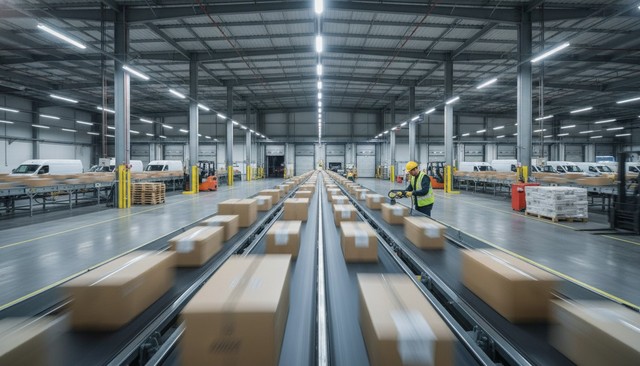
Parcel volumes across one South African courier network rose more than 26% year on year over November and December 2025, with December deliveries alone up nearly 40%. The operational answer to that surge - automation, direct system integration and proactive tracking - is now setting the expectation that B2B freight customers bring to the table.
Distribution
13 September 2026 • 4 min read
A Johannesburg courier hub now processes up to 6 000 parcels an hour. The significance for freight operators is not the throughput figure but what it normalises: a shipper who receives WhatsApp milestone updates on a R400 parcel will eventually ask why a R400 000 consignment offers less visibility.
Writing from operational data across Fastway Couriers' national network, the company's head of technology Danie Taljaard describes parcel volumes rising more than 26% year on year across November and December 2025, with December up almost 40%. He attributes the surge to both growing online demand and an increasing reliance on delivery by small and mid-sized retailers - businesses that previously sold across a counter and now ship.
His central operational claim is that peak is flattening into a permanent condition. Demand is becoming less seasonal and more continuous, which changes what a network has to be built for. A business sized for a two-month peak can staff its way through it; a business facing sustained elevated volume has to process more freight in shorter timeframes without raising error rates, and that is an automation problem rather than a headcount one.
Hub throughput: A Johannesburg courier hub processes up to 6 000 parcels an hour, sustaining accuracy through peak periods by automating sortation rather than adding labour. (Source: Logistics News / Fastway Couriers South Africa, 2026)
The shift with the widest read-across for freight is the one Taljaard describes in carrier integration. Direct API and SFTP connections were until recently the preserve of large shippers with development teams. Demand for them from small and mid-sized businesses has risen sharply, because those integrations let a business quote, generate labels and track consignments from inside its own systems - cutting administrative effort, human error and dispatch time.
The commercial implication is direct: logistics is expected to plug into how a customer already works, rather than requiring the customer to work the way logistics does. A transporter whose booking process still depends on a customer re-keying details into an email or a spreadsheet is imposing a cost that competitors have removed, and that cost is increasingly visible to the customer.
Three further shifts translate cleanly into regional freight. Affordability, Taljaard argues, now comes from operational efficiency - automation, route optimisation and system-led processes reducing cost per parcel - rather than from headline price cutting, a point worth holding onto in a market where undercutting is the default competitive reflex. Second, as e-commerce expands into electronics and premium goods, average consignment values are rising and businesses are taking up optional extended liability cover. Third, recipients now expect proactive updates via WhatsApp, SMS and email with clear milestones from collection to delivery.
That last point is where the parcel world and the freight world converge across SADC. Cross-border road freight has long treated communication as exception reporting - the customer hears from you when something goes wrong. Customers trained by parcel delivery expect the opposite: to be told where their goods are at defined points, without asking. In a region where border delays make absolute transit times hard to guarantee, being consistently informative about a delay is a more achievable differentiator than eliminating it.
Define three or four milestone events you can commit to reporting without being asked - collected, departed, at border, delivered - and send them proactively, because that is now the baseline your customer experiences elsewhere. Where you handle repeat business for the same client, offer a way for them to book and track without re-keying, even if it is a shared template rather than an API. And review whether your liability cover still matches the consignment values you are actually carrying, because average values have moved while many standing arrangements have not.
Stay connected with Southern Africa's freight and transport community.
Join 6,400+ logistics professionals across the SADC region.
Visit Laaimylorrie.com| About the Author | |

|
Andre Klynsmith Entrepreneur & Technology Enthusiast Andre's expertise spans technology, blockchain, transport, and logistics - with a passion for innovation and driving positive change across industries. |
| Source: Logistics News View source › | 16 February 2026 |


Subscribe to our Newsletter and stay in the know with all the latest Industry News, Products and Trends covering the whole of the SADC region.
KS Blockchain T/A Laaimylorrie.com . All Rights Reserved.