Industry related headlines to keep you in the know.
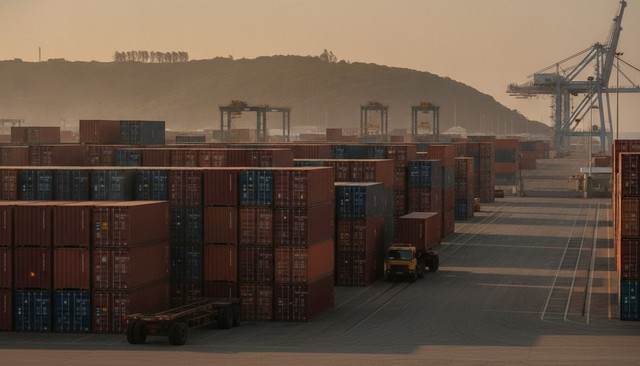
South Africa's economy contracted by 0.2% quarter on quarter in the second quarter of 2026, and the single biggest reason was the trade account: imports rose 4.9% while exports managed only 0.9%. For anyone moving freight in and out of Southern Africa, that gap is not an abstraction — it is a description of which lanes are busy and which are not.
Economy and Markets
12 September 2026 • 4 min read
The contraction ended six consecutive quarters of growth. It was driven not by a collapse in activity but by an imbalance — inbound volumes running well ahead of outbound ones. That is a freight pattern before it is an economic statistic, and it has direct consequences for how operators balance loads, price return legs and plan capacity into 2027.
Statistics South Africa reported a 0.2% quarter-on-quarter contraction for the second quarter of 2026, following downwardly revised growth of 0.4% in the first quarter. It is the first contraction since the third quarter of 2024 and it brought a run of six consecutive quarters of expansion to an end.
The composition matters more than the headline. Imports increased 4.9% over the quarter, led by machinery and electrical equipment and by mineral products. Exports rose only 0.9%, supported mainly by shipments of pearls, precious and semi-precious stones and precious metals. The Nedbank Group Economic Unit identified the sharp decline in net exports as the main factor behind the fall in expenditure on GDP. Gross fixed capital formation fell 0.2%, its second consecutive quarterly decline.
The imbalance in one line: imports +4.9%, exports +0.9% in the second quarter of 2026 — a widening gap that was the principal drag on expenditure-side GDP. (Source: Statistics South Africa, via Freight News, 2026)
On the production side the picture was uneven rather than uniformly weak. Seven industries recorded growth, and transport, storage and communication expanded by 0.9%, primarily on the back of increased land transport activity. Construction grew for a second consecutive quarter and agriculture recorded its seventh successive increase as horticultural and field-crop production rose.
Against that, Standard Bank macroeconomic analyst Christelle Grobler pointed to a sharp decline in trade activity alongside contractions in manufacturing and mining output. In other words, the sectors that generate the heaviest outbound tonnage went backwards while the sector that moves it grew slightly. Road freight volumes were being sustained by inbound and domestic work, not by export growth.
FNB and WesBank senior economist Thanda Sithole attributed part of the weakness to cost: the escalation of the Middle East conflict pushed international oil and domestic fuel prices sharply higher, raising transportation and production costs across the economy. Tighter financial conditions after the Reserve Bank's 25-basis-point policy rate increase in May added pressure on interest-sensitive demand. Sithole cautioned that the quarter reflected several temporary shocks and did not necessarily signal a sustained downturn.
Nedbank was blunter about what could come next, warning that the war in Iran could again produce a global supply-side shock, disrupting supply chains and driving oil and other commodity prices higher, which would in turn stoke inflation and force further monetary tightening. Grobler noted that growth comparable to last year's 1.1% remains possible, but that risks to the outlook have increased. For operators across the SADC region, that is the planning assumption: flat-to-modest demand growth with an unresolved fuel-price risk sitting on top of it.
An import-led trade gap means inbound lanes are carrying the growth and outbound lanes are flat, so empty-return exposure rises on export-facing routes and falls on import-facing ones — check whether your rate card still reflects that balance. Machinery, electrical equipment and mineral products were the import drivers, which points to where inbound volume is available. And with mining and manufacturing both contracting, do not build 2027 capacity on the assumption that export tonnage recovers on its own.
Stay connected with Southern Africa's freight and transport community.
Join 6,400+ logistics professionals across the SADC region.
Visit Laaimylorrie.com| About the Author | |

|
Andre Klynsmith Entrepreneur & Technology Enthusiast Andre's expertise spans technology, blockchain, transport, and logistics - with a passion for innovation and driving positive change across industries. |
| Source: Freight News View source › | 11 September 2026 |


Subscribe to our Newsletter and stay in the know with all the latest Industry News, Products and Trends covering the whole of the SADC region.
KS Blockchain T/A Laaimylorrie.com . All Rights Reserved.