Industry related headlines to keep you in the know.
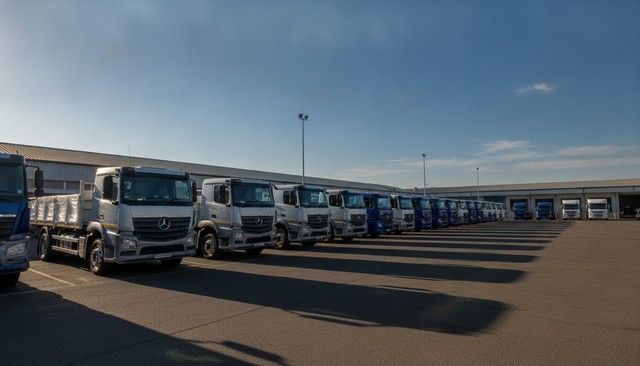
South African medium commercial vehicle sales rose 16.3% year on year in August 2026 and heavy trucks and buses gained 10.1% — even as wholesale diesel prices climbed by between 123.44 and 138.44 cents per litre during the same month.
ASSET MANAGEMENT
6 September 2026 • 4 min read
Private motorists got a 52 cent cut in August. Fleet operators got a diesel increase of up to R1.38 a litre. Naamsa's own reading of that split is blunt: commercial vehicle buying is now a whole-life operating economics decision, not a purchase price decision.
Naamsa, the Automotive Business Council, reported aggregate new vehicle sales of 57 898 units for August 2026, up 11.4% on the same month last year. Within that, medium commercial vehicles reached 805 units against 692 a year earlier, a gain of 113 units or 16.3%. Heavy trucks and buses reached 2 150 units against 1 952, up 198 units or 10.1%. Light commercial vehicles — bakkies and mini-buses — came in at 13 727 units, up 11.0%.
Dealer sales accounted for 81.8% of the total, or 47 364 units, with 13.4% going to the vehicle rental industry, 2.4% to government and 2.4% to industry corporate fleets. On the commercial side, FAW Trucks led with 546 units, followed by Toyota on 427, Isuzu on 303, and Daimler Truck and Volvo Trucks on 241 each. Exports moved the other way, falling 11.9% to 35 091 units.
The August cost divergence: petrol fell 52 cents per litre from 5 August, while wholesale diesel rose by between 123.44 and 138.44 cents per litre over the month. (Source: naamsa new vehicle sales media release, 2026)
The reinstated General Fuel Levy from 1 July 2026 added R1.50 a litre to petrol and R1.96 a litre to diesel, embedding a higher tax component in the fuel price. Naamsa noted that commercial operators then faced "a more challenging cost environment", with the August wholesale diesel increases "intensifying operating-cost pressures across freight, logistics and commercial vehicle fleets" — at the same time as motorists saw relief at the pump.
The council was explicit about what that does to purchasing behaviour: "This divergence is particularly significant for the automotive market because commercial vehicle purchasing decisions are strongly influenced by utilisation rates, fuel costs and whole-life operating economics." It added that the gap between improving conditions for private motorists and elevated operating costs for fleets "reinforces the increasing importance of total cost of ownership, vehicle efficiency and technology choice in purchasing and investment decisions". Pressure has not eased since: on 2 September, both petrol grades rose R1.34 a litre and wholesale diesel increased by between R2.93 and R3.15 a litre.
The backdrop is more settled than it has been. Headline consumer inflation moderated to 4.3% in July 2026 from 5.0% in June, and the Reserve Bank held the repo rate at 7.00%, leaving prime at 10.50%. Naamsa's reading is that the August performance does not signal a return to cheap credit but rather that "greater economic stability, improving product choice and more predictable financing conditions are helping to support vehicle demand".
Technology choice is entering the commercial fleet conversation too. New energy vehicle sales reached 16 289 units in the first seven months of 2026, an 88.0% increase on the same period last year and already 97.5% of the full 2025 total, split across 8 078 hybrids, 5 851 plug-in hybrids and 2 360 battery electric units — about 4.4% of all domestic new vehicle sales. Naamsa noted that "electrified commercial vehicles are also beginning to emerge across light, medium and extra-heavy applications, extending the transition beyond the passenger vehicle market."
When diesel moves by more than a rand a litre inside a single month, litres-per-100km stops being a specification detail and becomes the largest variable in your replacement model — a 5% consumption difference on a high-utilisation long-haul unit can outweigh a meaningful gap in purchase price over the asset's life. Rebuild the comparison on cost per kilometre at your actual utilisation, including fuel, maintenance contract, tyres, finance and expected residual, rather than on list price and monthly instalment. Operators in Namibia, Botswana and Zambia running South African-sourced units should note that the growth is in medium and heavy segments, which usually means better stock availability and more competitive dealer terms — a window worth using if a replacement decision is already due.
Stay connected with Southern Africa's freight and transport community.
Join 6,400+ logistics professionals across the SADC region.
Visit Laaimylorrie.com| About the Author | |

|
Andre Klynsmith Entrepreneur & Technology Enthusiast Andre's expertise spans technology, blockchain, transport, and logistics -- with a passion for innovation and driving positive change across industries. |
| Source: naamsa | The Automotive Business Council View source › | 1 September 2026 |


Subscribe to our Newsletter and stay in the know with all the latest Industry News, Products and Trends covering the whole of the SADC region.
KS Blockchain T/A Laaimylorrie.com . All Rights Reserved.