Industry related headlines to keep you in the know.
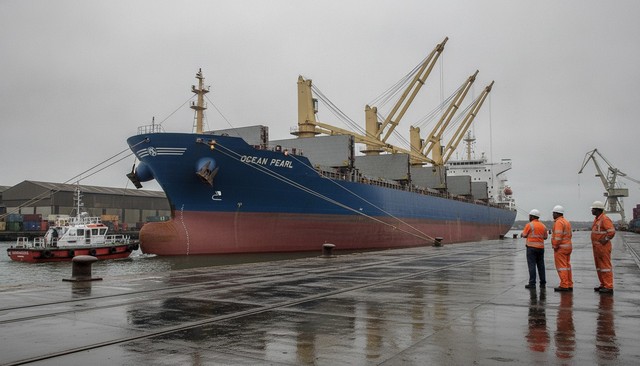
The Supramax dry bulk carrier Hawk S struck a quay at the Port of Durban on 31 August, damaging its hull. No injuries have been reported, and Transnet National Ports Authority has launched an investigation into the circumstances.
PORTS AND TERMINALS
6 September 2026 • 4 min read
A 40 576 deadweight tonne bulker built last year hit a quay in Durban and had to be moved to another berth. The cause has not been established — but for cargo owners and hauliers, the operational question is simpler and more urgent: which berth is out, and for how long?
Transnet National Ports Authority confirmed the incident on Thursday 3 September, after videos of the collision and its aftermath circulated widely on social media. "Emergency response and operational teams were immediately deployed to the scene and the vessel was relocated to an alternative berth for the necessary inspections to be undertaken," the authority said.
On cause and consequence, TNPA was deliberately non-committal: "At this stage, there have been no reports of injuries and investigations will commence as soon as possible to determine the circumstances surrounding the incident. TNPA is working closely with all relevant regulatory authorities and stakeholders in this regard." It added that "the safety of port users, employees, contractors and port infrastructure remains TNPA's highest priority."
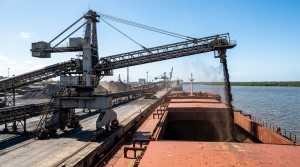
The vessel: Hawk S, a Supramax dry bulk carrier of 40 576 deadweight tonnes, built in 2025, Liberian flag, 180 metres length overall and 30 metres beam. AIS data showed it arriving at the Port of Durban on 31 August at 18:04. (Source: VesselFinder AIS data via Freight News, 2026)
Two gaps matter more than the incident itself. TNPA did not indicate whether the quay was damaged, and it did not say whether port operations were affected. The South African Maritime Safety Authority had not responded to questions from Freight News about the circumstances of the collision or its own role in the investigation.
What is publicly visible comes largely from four videos recorded from different angles and shared on WhatsApp and Facebook. One night-time clip appears to show the vessel approaching and striking the quay; a second shows water flowing from a damaged section of hull; daylight footage gives a clearer view of the visible damage. Social media footage is useful early evidence of an event, but it is not a berth status report, and operators should not plan against it.
Durban has spent recent weeks working through container-side congestion, elevated stack occupancy and vessels holding at anchorage. A quay incident on the dry bulk side does not directly touch container operations, but it consumes the same finite resources — marine services, inspection capacity, engineering assessment and, potentially, a berth taken out of rotation while structural checks are completed.
Whether a quay is structurally sound after a strike is a question with a long answer. Inspection, load assessment and any remedial work can hold a berth out of service well beyond the incident, and the effect on a port's schedule is felt as a queue rather than as a headline. Until TNPA states the berth's status, the only defensible planning assumption is that Durban's bulk berth capacity may be reduced.
If you have bulk cargo booked through Durban in September, ask your agent for berth status and revised laycan now rather than waiting for an official statement — a vessel moved for inspection is a scheduling event even when nothing is formally declared out of service. Landside operators should watch for knock-on effects on tipping and loading windows, because a berth reassignment moves the truck demand with it. And note the broader planning point for every SADC gateway: single-incident berth loss is a live risk at ports with limited redundancy, which describes Walvis Bay, Beira, Nacala and Maputo as much as it does Durban. Contracts that assume a named berth, rather than a named port, carry more exposure than they appear to.
Stay connected with Southern Africa's freight and transport community.
Join 6,400+ logistics professionals across the SADC region.
Visit Laaimylorrie.com| About the Author | |

|
Andre Klynsmith Entrepreneur & Technology Enthusiast Andre's expertise spans technology, blockchain, transport, and logistics -- with a passion for innovation and driving positive change across industries. |
| Source: Freight News View source › | 3 September 2026 |


Subscribe to our Newsletter and stay in the know with all the latest Industry News, Products and Trends covering the whole of the SADC region.
KS Blockchain T/A Laaimylorrie.com . All Rights Reserved.