Industry related headlines to keep you in the know.
National Treasury and SARS published an amendment to South Africa's Export Regulations on 25 August 2026 that allows movable goods delivered to licensed terminal operators — not only to the port authority — to qualify for VAT zero-rating. The change applies retrospectively from 1 April 2026 and closes a gap that had left exporters carrying a real tax risk on cargo they had already handed over for shipment.
POLITICS INSIGHT
29 August 2026 • 6 min read
The rule had not kept pace with how South African ports are actually run. At Richards Bay, the coal terminal is operated by one party and the port infrastructure by another — and until now only one of them counted for zero-rating purposes.
Under the previous rules, an exporter had to deliver goods to the port authority, the master of a ship, a container operator or the pilot of an aircraft, or bring them within the control area of an airport authority, in order to keep zero-rated treatment. The amendment adds terminal operators holding a port authority licence issued under sections 57 and 65 of the National Ports Act to that list of specified parties.
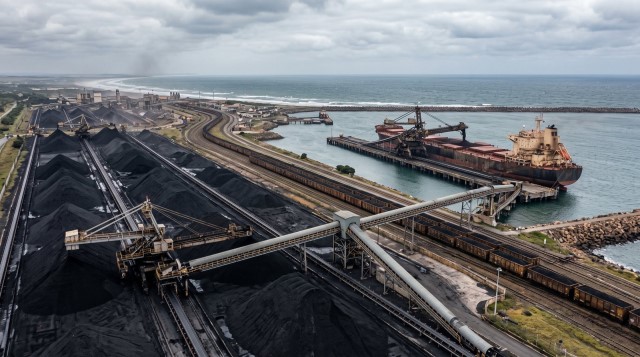
The practical mismatch was clearest at Richards Bay. Richards Bay Coal Terminal (RBCT) operates the coal terminals; Transnet National Ports Authority controls the wider port infrastructure. Coal delivered to RBCT was physically at the terminal from which it would be loaded onto a vessel, but RBCT was not the port authority named in the regulation. The paperwork and the physical reality had drifted apart.
What sits behind the rule: South Africa exported about 71.9 million tonnes of coal worth R95.4 billion in 2025, roughly 94% of it through RBCT and the Transnet-run Port of Richards Bay. (Source: SARS trade data / Ecofin Agency, 2026)
RBCT handled 57.66 million tonnes of coal in 2025, up from 52.08 million tonnes in 2024 and 47.21 million tonnes in 2023 — the highest level in four years, though still only about 63% of the terminal's 91-million-tonne design capacity. The recovery tracks improving rail performance: coal deliveries to RBCT averaged 1.17 million tonnes a week between 1 January and 20 April 2026, and by July, Transnet's bulk-rail performance had reportedly returned to pre-Covid levels, with 165 trains reaching RBCT in a single week.
Transnet Freight Rail said it expected to move around 62 million tonnes of coal to RBCT in 2026. The terminal had handled about 30 million tonnes by the end of June, putting it on course to clear 60 million tonnes for the year and targeting a sustainable annualised rate near 65 million tonnes. A procedural VAT obstacle sitting in the middle of a volume recovery of that scale is not a small thing.
The amendment is written around terminal operators generally, not around coal specifically. Any exporter delivering movable goods to a licensed terminal operator at a South African port now has a clear basis for zero-rating. That covers container terminals under private or partnership operation, dry-bulk and agri-bulk terminals, and the growing set of facilities moving to concession or partnership models.
It is also a marker of where South African port policy is heading. As more terminals move out of direct state operation and into licensed private or joint operation, the regulatory scaffolding written for a single state port operator has to be rewritten piece by piece. Customs, VAT, liability and documentation rules all assumed one counterparty. They increasingly face several.
The retrospective effect from 1 April 2026 is the part worth acting on now. Exporters and their advisers should review deliveries made since that date on the basis of the amended list, and confirm whether the party they physically delivered to holds a licence under sections 57 or 65. That determination, not the invoice wording, is what the zero-rating now turns on.
If you are an exporter, freight forwarder or clearing agent handling South African port deliveries, check who your delivery counterparty actually is and whether they hold a section 57 or 65 licence. The fix is retrospective to 1 April 2026, so it is worth reviewing this period's files rather than only changing the process going forward.
Stay connected with Southern Africa's freight and transport community.
Join 6,400+ logistics professionals across the SADC region.
Visit Laaimylorrie.com| About the Author | |

|
Andre Klynsmith Entrepreneur & Technology Enthusiast Andre's expertise spans technology, blockchain, transport, and logistics -- with a passion for innovation and driving positive change across industries. |
| Source: Ecofin Agency View source › | 28 August 2026 |


Subscribe to our Newsletter and stay in the know with all the latest Industry News, Products and Trends covering the whole of the SADC region.
KS Blockchain T/A Laaimylorrie.com . All Rights Reserved.