Industry related headlines to keep you in the know.
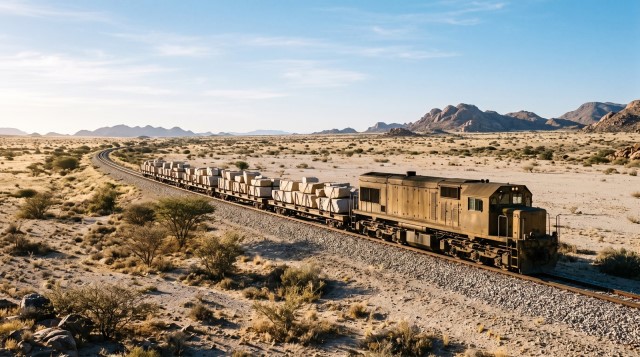
Rail currently carries less than 1% of Namibia's trade by transport mode — the single number that frames everything else in the country's rail programme, from the 185km Walvis Bay–Karibib service now running to the US$9.5 billion Trans-Kalahari Railway whose Phase 1 feasibility work was completed this year.
Railway
28 August 2026 • 5 min read
Almandro Jansen of Simonis Storm Securities makes the point plainly: 25,000 tonnes a month on the Walvis Bay–Karibib line is small against the millions of tonnes moving through Walvis Bay, but it is the first real commercial test of whether rail can take volume in Namibia at all. The 1,900km Trans-Kalahari Railway is the ambition. The sub-1% modal share is the starting position.
In July 2026, Kaleido Logistics and TransNamib launched a 185km freight rail service between Walvis Bay and Karibib. The target is 25,000 tonnes a month, and the operators estimate that hitting it removes roughly 735 heavy goods vehicle trips from the coastal road every month. The traffic is dimension stone, marble, granite and mineral bulk moving from inland producers to the port.
Jansen's assessment is deliberately unromantic. Set against total Walvis Bay throughput, 25,000 tonnes is marginal. What makes it significant is that it is a paying commercial service on existing track, with a named shipper base and a measurable modal-shift claim — the kind of evidence that a rail programme needs before anyone commits multi-billion-dollar capital to new alignments.
Namibia's rail arithmetic: rail carries under 1% of trade by transport mode; Walvis Bay–Karibib is 185km, targeting 25,000 t/month and ~735 fewer truck trips a month; the proposed Trans-Kalahari Railway is ~1,900km at an estimated US$9.5 billion, with Phase 1 feasibility completed in 2026. (Source: Simonis Storm Securities via Windhoek Observer, August 2026)
The larger project is the Trans-Kalahari Railway: a planned 1,900km line linking Walvis Bay with Windhoek, Gaborone and Johannesburg, now carrying an estimated cost of about US$9.5 billion with Phase 1 feasibility completed in 2026. The initial commercial driver is Botswana's coal exports, which have never had a west-coast outlet at scale. Beyond that, the study contemplates South African minerals and, in a higher-growth scenario, copper from the Democratic Republic of Congo.
The distance case is the strongest part of the argument. For copper originating in the western Copperbelt, the Walvis Bay routing is estimated at 1,500km to 2,000km shorter than either Dar es Salaam or Durban. On bulk mineral tonnage, that difference converts directly into transport cost and transit time — provided the line exists, and provided the volume commits.
A completed Phase 1 feasibility study establishes that a project can be built and roughly what it would cost. It does not establish that it will be built. US$9.5 billion on a cross-border alignment through three jurisdictions requires anchor tonnage contracts, sovereign or concessional finance, and an operating model that survives a commodity cycle. Botswana coal is the anchor on paper; whether it becomes the anchor in a signed take-or-pay agreement is the question the next phase has to answer.
Meanwhile the road corridor keeps working. The Trans-Kalahari road route between Walvis Bay, Gaborone and Gauteng already carries the traffic the railway is designed to capture, and will continue to for the entire construction period even in an optimistic scenario. For operators, the practical horizon is not the railway. It is whether more services like Walvis Bay–Karibib appear on existing TransNamib track in the next two to three years, and whether those services are reliable enough to plan around.
Nothing about the Trans-Kalahari Railway changes a 2026 or 2027 lane plan — but the Walvis Bay–Karibib service does, and more short-haul rail products on existing track are the realistic near-term development. If you move bulk or semi-bulk into or out of Walvis Bay, it is worth pricing a rail line-haul leg with road pre- and post-carriage now, while capacity is being sold to build a case. Road hauliers on the coastal leg should note that 735 truck trips a month is the volume the railway is explicitly targeting to take.
Stay connected with Southern Africa's freight and transport community.
Join 6,400+ logistics professionals across the SADC region.
Visit Laaimylorrie.com| About the Author | |

|
Andre Klynsmith Entrepreneur & Technology Enthusiast Andre's expertise spans technology, blockchain, transport, and logistics -- with a passion for innovation and driving positive change across industries. |
| Source: Windhoek Observer — Namibia faces race to secure Copperbelt freight View source › | August 2026 |


Subscribe to our Newsletter and stay in the know with all the latest Industry News, Products and Trends covering the whole of the SADC region.
KS Blockchain T/A Laaimylorrie.com . All Rights Reserved.