Industry related headlines to keep you in the know.
All three of Africa's main container sub-lanes moved flat or slightly lower on the Shanghai index in the week of 7 August 2026 -- and almost none of that relief reached the shippers actually paying the bills.
Shipping and Logistics
27 August 2026 • 5 min read
West Africa slipped 0.5%, South Africa edged up 0.2% and East Africa fell 1.0% -- yet all-in transaction rates into Durban, Lagos and Mombasa are barely off their June highs. The reason is not carrier discipline or demand. It is that congestion has become a fixed cost baked into the price, and fixed costs do not soften when the index does.
There are two ways to describe what an African import costs right now, and they are telling opposite stories. The Shanghai Containerized Freight Index sub-lanes -- the number quoted in market commentary -- put West Africa at 4,023 USD/TEU, South Africa at 2,791 and East Africa at 3,408 in the 7 August week, all flat to marginally lower. The all-in rate a forwarder actually transacts tells a different story: roughly US$4,200 to US$5,000 per 40ft into Lagos, US$3,015 to US$3,685 into Durban or Cape Town, and US$4,800 to US$5,000 into Mombasa.
The gap between those two figures is not a rounding error or a forwarder's margin. It is surcharges, and surcharges are where congestion gets priced. Peak season surcharges, container imbalance charges, war risk and emergency fuel layers now stack on top of base freight, and they are set on operational reality rather than on a spot index that measures only base rate movement on the trade.
The composite moved the other way: the overall SCFI composite rose from 3,276.14 on 7 August to 3,355.24 on 14 August, up 2.4% -- driven almost entirely by United States lanes, while all three African sub-lanes moved flat to lower. (Source: Great Hensen / SSE, August 2026)
Africa's lanes have decoupled from the global rate cycle for a structural reason. The crisis premiums currently inflating Middle East and transpacific pricing sit on the Asia-Europe and Asia-North America axes. Southern African cargo is not on those axes. For this region, the Red Sea diversion is something that passes overhead: vessels route around the Cape, port calls increase, bunkering volumes rise, and transshipment work lands in East African terminals -- but the crisis premium itself never ignites the local base rate.
The measurable effect of Cape routing has been a roughly 25% year-on-year increase in South African port calls. That is more work for the same infrastructure, and it lands on terminals that were already stretched. Ultra-large vessel inflows now exceed what the quay and the yard were built to absorb, which is precisely how a shipping-market tailwind becomes a landside problem.
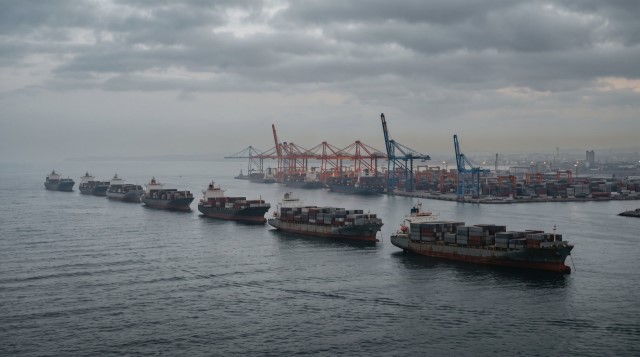
Three physical constraints are holding the price floor in place. Lagos Apapa runs anchorage waits of 14 to 21 days and is currently the most congested container port in the world. Durban's Pier 2 gateway operation has been running 5 to 9 day delays through the August system transition. Mombasa and Dar es Salaam are absorbing record transshipment volumes, with equipment and yard space -- not demand -- as the binding constraint.
None of that disappears when demand softens. A carrier facing a two-week anchorage queue burns the same fuel, pays the same crew and loses the same vessel days whether the box on board is moving at peak-season prices or at a discount. That cost gets recovered somewhere, and it is recovered in the surcharge stack. Which is why the useful forward-looking question for the rest of 2026 is not what the index does. It is whether Durban's terminal recovery holds -- because that is the single biggest variable on the South African lane, and the only one capable of pulling the floor down.
Stop quoting clients off index movement and start quoting off all-in landed cost, with quote validity shortened to a few days while the surcharge stack is this volatile. Build 10 to 14 days of buffer into delivery commitments on Durban-routed cargo, and treat Cape Town and Gqeberha as genuine alternatives for high-value and reefer loads rather than fallback options. For inland Zambian, Zimbabwean and Botswanan cargo, the arithmetic on Walvis Bay and Beira versus Durban changes materially once a nine-day terminal delay is priced into the road leg.
Stay connected with Southern Africa's freight and transport community.
Join 6,400+ logistics professionals across the SADC region.
Visit Laaimylorrie.com| About the Author | |

|
Andre Klynsmith Entrepreneur & Technology Enthusiast Andre's expertise spans technology, blockchain, transport, and logistics -- with a passion for innovation and driving positive change across industries. |
| Source: Great Hensen International Logistics -- Africa Shipping Rates August 2026 Deep Analysis View source › | 20 August 2026 |


Subscribe to our Newsletter and stay in the know with all the latest Industry News, Products and Trends covering the whole of the SADC region.
KS Blockchain T/A Laaimylorrie.com . All Rights Reserved.