Industry related headlines to keep you in the know.
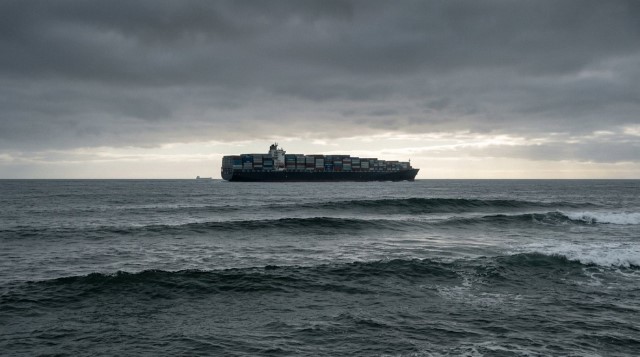
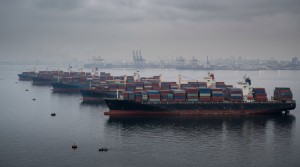
The 60-day ceasefire between the United States and Iran expired on Monday 17 August 2026 without a permanent agreement, and traffic through the Strait of Hormuz has fallen since. At the same time, renewed Houthi activity has been reported in the Bab el-Mandeb Strait. Two of the routes that carry cargo to and from this region are under pressure simultaneously.
Supply Chain Management
24 August 2026 • 5 min read
Contingency planning normally assumes that when one route closes, another opens. Two chokepoints degrading in the same fortnight removes that assumption. For a landlocked SADC importer, the practical effect is not a headline -- it is a lead time that no longer behaves the way the last order cycle did.
The ceasefire rested on a fourteen-point memorandum of understanding intended to end hostilities and restore freedom of navigation through the Strait of Hormuz. It lapsed with no replacement. Reporting since has described Iran signalling a shift from a defensive to a more aggressive posture, the seizure of a tanker in the strait, and a sharp increase in rhetoric from Washington. Vessel transits have declined.
Kuehne+Nagel flagged both chokepoints in the same weekly operational update, noting that the risk of wider regional conflict has increased following renewed Houthi activity in the Bab el-Mandeb. That is a meaningful pairing: Hormuz governs the Gulf, Bab el-Mandeb governs the Red Sea approach, and a great deal of Southern African trade is routed relative to one or the other.
The compounding factor: Many services are already routing via the Cape of Good Hope, adding roughly ten days to some voyages and absorbing vessel capacity that would otherwise be available elsewhere. (Source: Kuehne+Nagel operational updates, 2026)
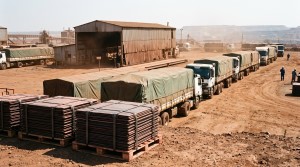
The obvious exposure is fuel, and it is real: bunker prices respond to Gulf risk within days, and carrier fuel surcharges follow. The less obvious exposure is inbound industrial inputs. Southern Africa draws heavily on Gulf-sourced chemical feedstock, and the Copperbelt's hydrometallurgical operations depend on a reagent supply chain that begins there. A mine that cannot leach does not produce, regardless of the copper price -- and the trucks contracted to move that metal do not move either.
That is the transmission mechanism worth understanding. A chokepoint event thousands of kilometres away reaches a Zambian or Namibian haulier not as a shipping story but as a customer whose production schedule has slipped, whose inbound volumes are lumpy, and whose committed tonnage suddenly arrives in a different shape.
Nobody can forecast the political outcome, and it is not worth pretending otherwise. What can be done is to make the planning assumptions explicit. Which lanes touch either strait, directly or through a transhipment hub. What the current planned transit is, and what a ten-day extension would do to the reorder point. Whether the surcharge clause in the freight contract is written against fuel price alone, which will not capture a war-risk or security charge.
For transport operators, the equivalent exercise is on the demand side. Ask the two or three customers who account for most of your volume what their inbound dependency looks like, and whether their production plan assumes uninterrupted Gulf supply. The answer determines whether your fourth-quarter capacity commitment is sound.
Re-run reorder points and safety stock on a longer, wider transit distribution rather than a single planned figure, and check that your freight contracts name security and war-risk charges separately from fuel adjustment. Then map your customers' inbound dependencies, not just their outbound tonnage -- that is where a chokepoint event will reach your vehicle utilisation first.
Stay connected with Southern Africa's freight and transport community.
Join 6,400+ logistics professionals across the SADC region.
Visit Laaimylorrie.com| About the Author | |

|
Andre Klynsmith Entrepreneur & Technology Enthusiast Andre's expertise spans technology, blockchain, transport, and logistics -- with a passion for innovation and driving positive change across industries. |
| Source: Kuehne+Nagel -- Hormuz tensions rise as US-Iran truce expires View source › | 18 August 2026 |


Subscribe to our Newsletter and stay in the know with all the latest Industry News, Products and Trends covering the whole of the SADC region.
KS Blockchain T/A Laaimylorrie.com . All Rights Reserved.