Industry related headlines to keep you in the know.
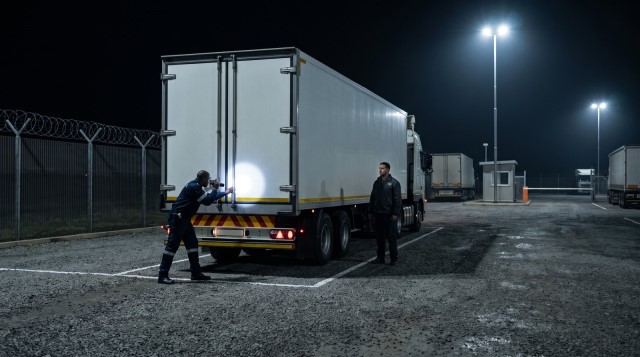
A decade ago, security accounted for roughly 0.3% of a South African road freight operator's total operating costs. It now sits at about 2.3%, and rises to as much as 4.1% for operators carrying cash, electronics, fuel, spirits and medicines. That shift has happened inside the life of a single truck finance agreement, and most rate cards have not moved with it.
Business Insights
22 August 2026 • 5 min read
Most operators treat security as an overhead -- a fixed grudge purchase absorbed somewhere below the fuel line. The numbers say it has become a variable cost that moves with route, commodity and time of day. Costs that behave like variables and get priced like overheads are exactly where margin disappears without anyone being able to point at the leak.
South African Police Service crime statistics point to between 30 and 35 truck hijackings reported every week. Industry estimates put truck hijacking at roughly an R8.5 billion business. Those are national numbers, but the exposure is not evenly spread: Delmas recorded the highest incident count at 53, followed by Orange Farm at 48, Kempton Park at 47 and Alberton at 42.
The Road Traffic Management Corporation has identified high-risk sections of the N1, N2 and N3, the Moloto Road (R573) and the R71 in Limpopo. Read alongside the hotspot list, that is not a map of the country -- it is a map of the Gauteng industrial belt and the corridors radiating out of it, which is where most SADC-bound line-haul begins or ends.
What that means per kilometre: Against 2026 rate guidance putting long-haul cost per kilometre at around R20.33, a 2.3% security load is roughly R0.47/km and a 4.1% load roughly R0.83/km -- about R280 versus R500 on a single 600 km leg. (Source: Laaimylorrie.com calculation on published 2026 CPK guidance)
Syndicates now use signal jammers, diversion tactics and planted employees to reach cargo. GPS jamming, fake blue lights and cyber intrusion into dispatch systems all feature. Each of those defeats a specific control that operators have already paid for: jamming defeats tracking, false authority defeats the driver's stop-only-for-police rule, and insider placement defeats route confidentiality entirely.
This is why simply buying more of the same tracking does not move the loss numbers. The controls that still work are procedural and expensive in a different way -- vetted crew, randomised departure timing, secured overnight stops, escort on defined sections, and dispatch systems treated as a security perimeter rather than an office application.
The practical fix is to separate the security load out of general overhead and attach it to the load characteristics that actually drive it: commodity class, route section, and whether the trip requires a night stop. An operator who can show a shipper that a Gauteng-to-coast run carrying high-theft commodities carries a measurably different security cost to a bulk agricultural run on the same distance has a defensible basis for two different rates.
Without that separation, the operator carrying the risky freight subsidises the operator carrying the safe freight inside its own rate card -- and the shipper with the most attractive cargo for criminals pays the same per kilometre as everyone else. That is not a market failure. It is a costing failure, and it is fixable in a spreadsheet.
Pull your last twelve months of security spend -- tracking subscriptions, escorts, secure parking, guarding, insurance excess and claims -- and express it as a percentage of total operating cost. If it is above 2%, it is too big to sit in overhead. Rebuild it as a per-kilometre or per-trip loading that varies by commodity and route, and put that line on the quote where the customer can see it. Shippers negotiate hard on a number they cannot see; they negotiate reasonably on one they can.
Stay connected with Southern Africa's freight and transport community.
Join 6,400+ logistics professionals across the SADC region.
Visit Laaimylorrie.com| About the Author | |

|
Andre Klynsmith Entrepreneur & Technology Enthusiast Andre's expertise spans technology, blockchain, transport, and logistics -- with a passion for innovation and driving positive change across industries. |
| Source: Freight News -- Crime and regulation tighten pressure on road freight View source › | 2026 |


Subscribe to our Newsletter and stay in the know with all the latest Industry News, Products and Trends covering the whole of the SADC region.
KS Blockchain T/A Laaimylorrie.com . All Rights Reserved.