Industry related headlines to keep you in the know.
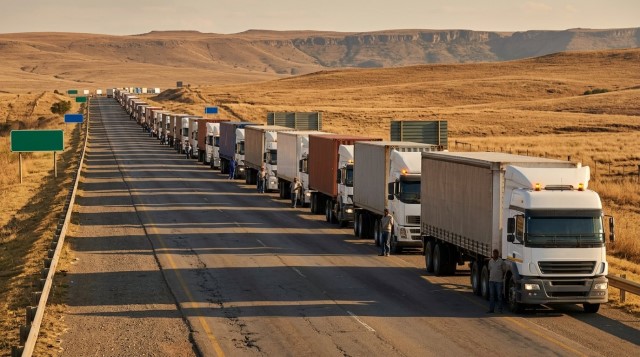
Negotiations over the employment of foreign truck drivers in South Africa have broken down, and the organisation that has called every major road-freight shutdown of the past three years says there are currently no engagements under way. For operators running the N3, N1 and the cross-border legs into Zimbabwe, Mozambique and Botswana, that is not a labour headline -- it is a route-availability problem with no fixed date on it.
Transportation
21 August 2026 • 4 min read
The All Truck Drivers Forum and Allied South Africa says talks on an eleven-point plan covering foreign driver employment have collapsed, with no engagements in progress. The grievance has produced blockades before. The difference in 2026 is that the freight system it would disrupt is carrying more volume, with thinner recovery margins, than it was the last time this happened.
ATDF-ASA national secretary Gugu Sokhela confirmed in early August that discussions on an eleven-point plan dealing with the employment of foreign drivers had stalled, and that no engagements were taking place. The organisation's position is that a 2021 agreement reached with the ministers of transport, labour, police and home affairs produced nothing tangible, and that the hiring of cheaper foreign drivers has continued at the expense of South African citizens.
The immediate consequence is procedural rather than dramatic: without a negotiating forum, there is no mechanism through which the dispute gets resolved, and no counterpart who can call off an action once it is announced. That is the part operators should be planning around. A dispute with an active negotiation has an off-ramp. A dispute without one escalates by default.
Where the dispute stands: Talks on an eleven-point plan covering foreign driver employment were reported as broken down in early August 2026, with ATDF-ASA stating that no engagements were under way and that a 2021 agreement with four national ministers had not been implemented. (Source: News24, 2026)
Previous actions in this dispute have not taken the form of a conventional strike inside a single employer. They have taken the form of route interference -- vehicles stopped on national roads, convoys blocked at chokepoints, and drivers prevented from continuing regardless of who employs them or what they are carrying. A haulier with a fully South African crew and a clean labour record is exposed to exactly the same delay as the operator the action is aimed at.
That distinction matters for how the risk is priced. This is not an employment-relations exposure that sits with the HR function. It is a corridor-availability exposure that sits with dispatch, and it behaves like weather or a border closure: unpredictable in timing, geographically concentrated, and costly mainly through the vehicles it strands rather than the hours it removes.
South Africa is the transit country for a large share of SADC's inland freight. A truck moving copper from the Copperbelt to Durban, or containers from Durban to Gaborone and Harare, spends most of its journey on South African national roads. Disruption on the N3 between Durban and Gauteng, or on the N1 north of Pretoria, reaches Zambian, Zimbabwean, Botswanan and Namibian consignments within a single shift.
Operators outside South Africa therefore carry the risk without any standing in the dispute. Their practical options are contractual and operational -- force majeure language that recognises third-party road interference, alternative gateway planning through Walvis Bay, Maputo or Beira for time-critical cargo, and a clear internal rule on when a driver stops and parks rather than attempting to push through a blockade.
Treat this as a corridor risk with no scheduled resolution date rather than a labour story to monitor. Check that your customer contracts and cargo insurance recognise third-party road interference as a delay cause, brief drivers on a stop-and-park protocol instead of pushing through, and identify in advance which loads you would reroute through an alternative gateway if the N3 or N1 becomes unusable for a day or more.
Stay connected with Southern Africa's freight and transport community.
Join 6,400+ logistics professionals across the SADC region.
Visit Laaimylorrie.com| About the Author | |

|
Andre Klynsmith Entrepreneur & Technology Enthusiast Andre's expertise spans technology, blockchain, transport, and logistics -- with a passion for innovation and driving positive change across industries. |
| Source: News24 -- Possible freight shutdown looms as tensions rise over foreign driver employment View source › | 5 August 2026 |


Subscribe to our Newsletter and stay in the know with all the latest Industry News, Products and Trends covering the whole of the SADC region.
KS Blockchain T/A Laaimylorrie.com . All Rights Reserved.