Industry related headlines to keep you in the know.
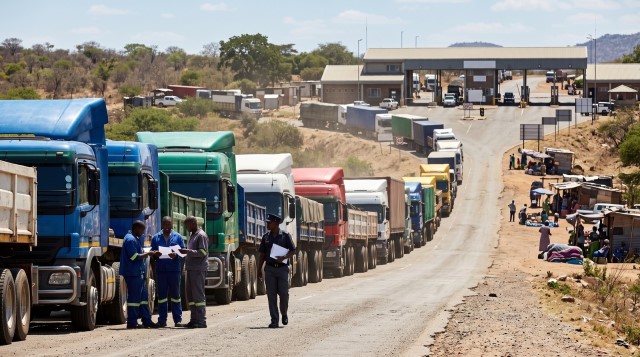
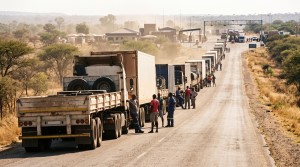
Median crossing times at South Africa's borders have risen to close to ten hours, while several regional crossings -- Chirundu, Kasumbalesa and Katima Mulilo among them -- regularly exceed 24 hours. The problem for supply chain planners is not the average. It is the spread around it.
Supply Chain Management
18 August 2026 • 4 min read
A border that reliably takes ten hours can be planned around. A border that takes six hours on Tuesday and thirty on Thursday cannot -- and the difference is paid for in safety stock, missed slots and buffer days that sit on someone's balance sheet.
Inventory theory is unforgiving on this point. Safety stock is driven not by average lead time but by the variability of lead time. Halving the average transit while leaving the variability untouched barely moves the amount of stock a distributor must hold. Cutting the variability, even at an unchanged average, releases working capital immediately.
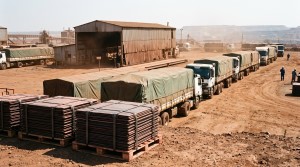
SADC's border posts are a textbook source of variance. Kasumbalesa is the clearest example: five regional trade corridors converge there, on infrastructure that has not kept pace with the volume. In 2025, more than 1,500 trucks were stranded at the crossing when an electronic seals clearance system introduced on the DRC side caused sustained processing delays. Nothing about the physical route changed -- a procedural change alone produced a multi-day queue.
Border reality: Median crossing time at South African borders is approaching 10 hours, while Chirundu, Kasumbalesa and Katima Mulilo continue to record delays in excess of 24 hours. (Source: Reload Logistics African border delays review, 2026)
The SADC Secretariat's Directorate of Finance, Investment and Customs is running a series of border workshops through August 2026 to prepare officials and traders for formal introduction of the Simplified Trade Regime. The Mwanza/Zobue post on the Malawi-Mozambique border hosts sessions on 23-24 August, with parallel work involving Tanzania and Zambia.
Two mechanisms sit at the centre of the regime. The first is a Simplified Certificate of Origin issued directly to the trader at the crossing, removing a document that has historically required advance preparation elsewhere. The second is the Trade Information Desk, staffed by dedicated officers whose function is to walk traders through compliance rather than penalise them for getting it wrong. Both are aimed primarily at small-scale and informal cross-border trade -- a segment dominated by women and younger traders, and one where uncertainty at the border has long translated into harassment and unofficial payments.
It is tempting for commercial hauliers to treat the Simplified Trade Regime as somebody else's programme. That would be a mistake. Small-scale traders queue in the same lanes, occupy the same counters and consume the same officer time as commercial consignments. Every trader who arrives with a valid simplified certificate instead of an unresolved documentation problem shortens the queue behind them.
The broader trajectory is consistent. The SADC Protocol on Trade commits members to harmonised customs procedures, simplified documentation and risk-based inspection -- the last of which is the single largest available lever, because it replaces inspecting everything with inspecting what the data flags. Combined with the pre-clearance requirements now being enforced in markets such as Botswana, the direction is clear: paperwork is moving upstream, away from the gate.
Start recording actual crossing times per border post, per day of week -- not a single corridor average. That data is what lets you quote a realistic transit window, defend it commercially, and show a customer exactly where their buffer stock is going. Where you serve customers holding inventory against border risk, sell reliability rather than speed: a narrow, evidenced transit window is worth more to a distributor than a fast one they cannot count on.
Stay connected with Southern Africa's freight and transport community.
Join 6,400+ logistics professionals across the SADC region.
Visit Laaimylorrie.com| About the Author | |

|
Andre Klynsmith Entrepreneur & Technology Enthusiast Andre's expertise spans technology, blockchain, transport, and logistics -- with a passion for innovation and driving positive change across industries. |
| Source: SADC Secretariat -- Border workshops roll out the Simplified Trade Regime View source › | August 2026 |


Subscribe to our Newsletter and stay in the know with all the latest Industry News, Products and Trends covering the whole of the SADC region.
KS Blockchain T/A Laaimylorrie.com . All Rights Reserved.