Industry related headlines to keep you in the know.
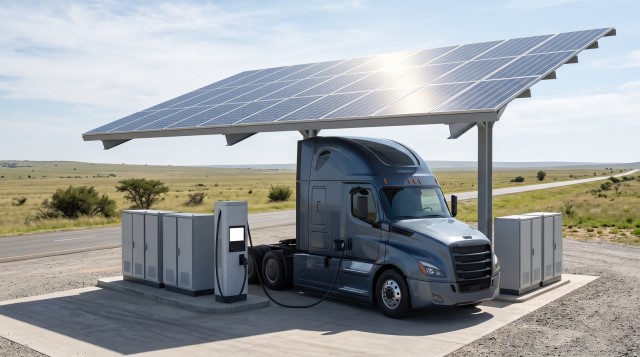
South Africa's first electric truck charged at a fully off-grid, solar-powered ultra-fast station was recorded near Wolmaransstad in January 2026, and the company behind it is now rolling out solar charging hubs along the busy N3 freight corridor.
Carbon Footprint
11 August 2026 • 5 min read
Electric trucks have always faced two hard questions in South Africa: where do you charge them, and where does the power come from on an unreliable grid? Solar-powered off-grid charging answers both at once -- and it is now appearing on the country's most important freight route.
In January 2026, Cape Town-based Zero Carbon Charge marked a first for the country: an electric truck charged at a fully off-grid, solar-powered ultra-fast public charging station near Wolmaransstad. The company is now extending these hubs along the N3, the arterial corridor linking Gauteng's industrial heartland to the Port of Durban.
The design matters. By generating power on-site with solar and storing it in batteries, an off-grid hub sidesteps the two problems that have stalled electric freight: the cost and delay of new grid connections, and the risk of load-shedding cutting a charge mid-session. For long-haul routes far from reliable substations, self-powered charging may be the only model that works.
Market signal: South Africa's electric truck market was worth about USD 7.5 million in 2025 and is projected to reach roughly USD 56.5 million by 2034, a growth rate above 25% a year. (Source: IMARC Group, 2026)
Government has started to act on the supply side. A 150% tax deduction on qualifying electric-vehicle production investment came into effect in March 2026, a meaningful incentive for local manufacturing. Electric truck models from Volvo, Maxus, JAC and Foton are now available in the market.
What is still missing is a demand-side incentive. There is no fleet purchase subsidy to close the gap between an electric truck's high upfront price and a diesel equivalent. Until that arrives, adoption is likely to stay concentrated in mining and heavy-transport operators with sustainability mandates and the balance sheets to absorb the premium.
For most SADC hauliers, diesel remains the workhorse and will for years. Electric freight makes sense first on fixed, high-utilisation routes where a truck returns to the same depot nightly and where charging infrastructure exists or can be self-generated. The N3 corridor, with its predictable Gauteng-Durban shuttle traffic, is a logical proving ground.
The honest reading is that electric trucking in the region is at the pilot stage, not the tipping point. But the arrival of off-grid solar charging removes one of the biggest structural objections, and shippers with green commitments in their contracts should start understanding the option now rather than when a customer demands it.
Electric freight is not yet a fleet-wide decision, but it is becoming viable on fixed, high-utilisation corridor routes as off-grid solar charging removes the grid-connection and load-shedding risks. If your customers are starting to ask about emissions, map which of your regular lanes could pilot an electric unit before the question becomes a contract requirement.
Stay connected with Southern Africa's freight and transport community.
Join 6,400+ logistics professionals across the SADC region.
Visit Laaimylorrie.com| About the Author | |

|
Andre Klynsmith Entrepreneur & Technology Enthusiast Andre's expertise spans technology, blockchain, transport, and logistics -- with a passion for innovation and driving positive change across industries. |
| Source: CleanTechnica -- Electric Trucking: Why Ecosystem Readiness Matters In South Africa View source › | 11 August 2026 |


Subscribe to our Newsletter and stay in the know with all the latest Industry News, Products and Trends covering the whole of the SADC region.
KS Blockchain T/A Laaimylorrie.com . All Rights Reserved.