Industry related headlines to keep you in the know.
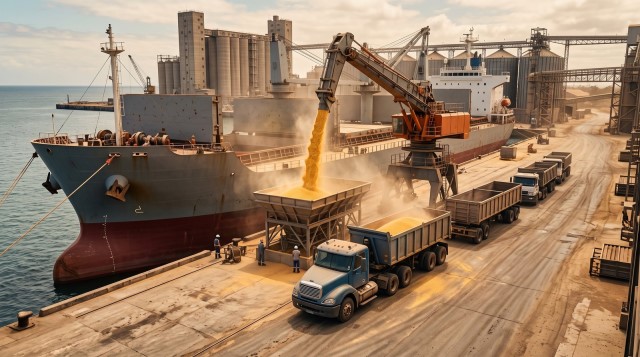
South Africa -- the source of roughly 88% of the region's maize exports -- is set to import yellow maize for a second consecutive season in 2025/26, a quiet reversal that carries real consequences for the feed, poultry and inbound-grain logistics chains across Southern Africa.
Supply Chain Management
4 August 2026 • 5 min read
When the region's biggest grain exporter starts buying grain from the outside, the direction of freight changes. Inbound bulk handling, port grain capacity and currency exposure all move to the foreground -- and the operators who plan for it early avoid paying for it later.
South Africa remains the dominant maize supplier in Southern Africa, accounting for about 88% of the region's exports -- mainly white maize to regional neighbours and yellow maize to markets further afield. In the 2024/25 season it still exported over 770,000 tonnes of yellow maize to buyers including Zimbabwe, Botswana, Eswatini, Mozambique, Namibia and Lesotho.
Yet the country is now expected to import yellow maize again in 2025/26 -- the second consecutive season it has needed to do so. The driver is demand rather than a failed harvest: the 2025/26 crop is estimated at a healthy 16.8 million tonnes, but domestic use of around 12 million tonnes a year, led by animal feed, is pulling yellow maize in even as white maize surpluses continue to flow out.
The balance: A 2025/26 maize crop estimated at about 16.8 million tonnes against domestic use of roughly 12 million tonnes a year -- with yellow maize imports required for a second straight season to meet feed demand. (Source: Agbiz / SA Grain, 2026)
Southern Africa's grain logistics were built primarily to move surplus outward -- from inland silos to export ports and across borders to deficit neighbours. Importing yellow maize runs that flow in reverse: bulk vessels discharging at port, grain moving inland by rail and road to feed mills rather than outward to ships. That is a different set of demands on port grain terminals, bulk handling equipment and inland haulage, and it competes for the same capacity that the export programme relies on.
For the feed and poultry sector, which sits at the end of this chain, the exposure is direct. Imported grain is priced in dollars and paid before it is milled, so a weaker rand and firm global freight rates both feed straight into input costs. A supply chain that assumed steady domestic supply now has to manage import timing, port availability and currency in a way it did not a few seasons ago.
This season's crop was helped by La Niña rainfall that lifted plantings. The concern is what comes next: forecasters point to a possible transition to El Niño in late 2026 and through 2027, a pattern that typically brings below-average rainfall to Southern Africa. If the next summer crop underperforms, the region's import reliance could deepen at exactly the moment several neighbouring countries face their own drought-reduced harvests.
That makes the current import season more than a one-off adjustment. It is a stress test of how well the region can pivot its grain logistics from export mode to import mode -- and a reminder that food-supply resilience is, at bottom, a logistics problem as much as an agricultural one.
Grain freight is no longer a one-way outbound flow -- operators serving feed mills and ports should plan for inbound bulk volumes, and book port and rail capacity for imports before the peak feed-demand window tightens it. Feed and poultry buyers should hedge import timing and currency exposure now rather than in a shortage, and everyone in the chain should treat the 2026/27 El Niño outlook as a live planning input, not a distant risk.
Stay connected with Southern Africa's freight and transport community.
Join 6,400+ logistics professionals across the SADC region.
Visit Laaimylorrie.com| About the Author | |

|
Andre Klynsmith Entrepreneur & Technology Enthusiast Andre's expertise spans technology, blockchain, transport, and logistics -- with a passion for innovation and driving positive change across industries. |
| Source: Food For Mzansi / SA Grain -- SA maize imports & 2026 grain outlook View source › | 4 August 2026 |


Subscribe to our Newsletter and stay in the know with all the latest Industry News, Products and Trends covering the whole of the SADC region.
KS Blockchain T/A Laaimylorrie.com . All Rights Reserved.