Industry related headlines to keep you in the know.
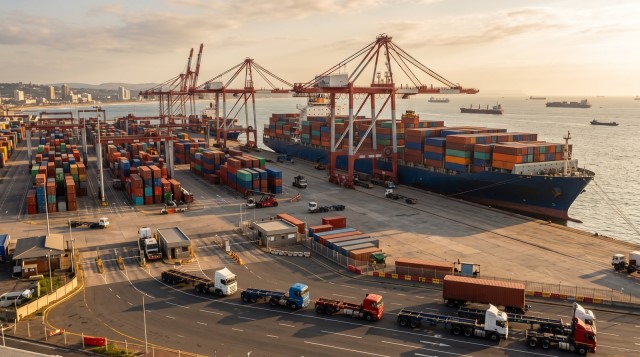
Ocean freight rates on the Far East–Southern Africa trade have firmed sharply as the 2026 peak season builds, with China–South Africa container prices up 12–25% since June and inland transport capacity emerging as the real constraint on landed cost.
Shipping and Logistics
1 August 2026 • 4 min read
A firming ocean market is pushing import costs up just as peak season loads the pipeline. For SADC importers and exporters, the bigger risk is no longer the sea leg — it is getting the box off the quay and onto the road before demurrage bites.
Container rates from China into South Africa have moved up as carriers tighten capacity ahead of the fourth-quarter shipping peak. A 20-foot box into Durban or Cape Town is now quoted broadly in the US$2,400–2,900 range, with 40-foot equipment closer to US$3,100–3,800 — increases of roughly 12–25% on June levels. Less-than-container-load cargo has held steadier at around US$150 per cubic metre, though consolidation delays can still add days at destination.
The move reflects a familiar seasonal pattern: importers front-loading stock ahead of the festive and summer trading window, carriers managing space, and rate quotes drifting upward as vessels fill. For SADC buyers whose goods route through South African gateways before moving inland to Zambia, Zimbabwe, Botswana, the DRC and beyond, every dollar of rate increase compounds across a longer landed-cost chain.
Rate snapshot: China–South Africa ocean rates have risen roughly 12–25% since June 2026, with 20ft boxes into Durban quoted around US$2,400–2,900. (Source: Sino Shipping / MoverDB freight rate trackers, July 2026)
Despite well-documented congestion challenges, the Port of Durban remains the busiest container gateway on the continent and the default entry point for time-sensitive SADC imports, handling more than 880 vessel calls a month across a 59-berth complex. For high-value or perishable cargo, that reliability premium still matters — even when Maputo, Walvis Bay and Ngqura increasingly compete for diverted volumes.
But the sea freight quote is only half the story. Once a container lands, the clock starts on free time, and inland trucking and rail slots into the interior remain under pressure. A cheap ocean rate is quickly eaten up by demurrage, storage and last-minute road haulage if the landside leg has not been arranged in advance.
In a rising market, the operators who protect margin are the ones who lock in landside capacity before the box arrives, not after. That means confirming trucking or rail movement at the time of booking, pre-clearing customs paperwork, and building realistic buffers for deconsolidation at Cape Town and inland depots.
It also means shopping the landside leg as competitively as the sea leg. With ocean rates firming, the controllable saving increasingly sits in the domestic haulage and clearance segment — exactly where a deep pool of vetted transporters and freight quotes turns a cost pressure into a planning advantage.
Budget for higher ocean rates through Q4 and quote landed cost, not sea freight in isolation. Arrange inland trucking and rail at the point of booking, pre-clear paperwork, and treat reliable landside capacity as the segment where the peak-season saving is actually made.
Stay connected with Southern Africa's freight and transport community.
Join 6,400+ logistics professionals across the SADC region.
Visit Laaimylorrie.com| About the Author | |

|
Andre Klynsmith Entrepreneur & Technology Enthusiast Andre's expertise spans technology, blockchain, transport, and logistics — with a passion for innovation and driving positive change across industries. |
| Source: Sino Shipping / MoverDB freight rate trackers & SeaRates View source › | 1 August 2026 |


Subscribe to our Newsletter and stay in the know with all the latest Industry News, Products and Trends covering the whole of the SADC region.
KS Blockchain T/A Laaimylorrie.com . All Rights Reserved.