Industry related headlines to keep you in the know.
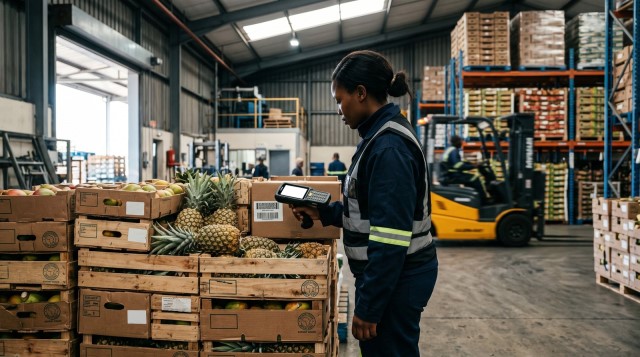
A new class of European import rules is turning cargo traceability from a nice-to-have into a condition of market access — and for SADC exporters of timber, coffee, cocoa, rubber and cattle products, the data burden is landing squarely on the logistics chain that moves the goods. The technology question for 2026 is no longer whether to track shipments, but whether your systems can prove where a consignment came from.
TECHNOLOGY AND TRENDS
22 July 2026 • 6 min read
Compliance used to be a document at the border. It is becoming a data trail that starts at the farm or forest and follows the consignment all the way to the ship. Whoever controls that trail controls the shipment.
The European Union's Deforestation Regulation, or EUDR, requires companies placing certain commodities on the EU market to prove the goods were not produced on land deforested after 31 December 2020. That proof comes through due-diligence statements backed by geolocation data for the plot of origin. The regime is phasing in through 2026 and 2027, with larger operators facing application around the end of 2026 and enforcement mechanisms already taking shape.
The commodities in scope — cattle, cocoa, coffee, palm oil, rubber, soya and wood — are central to many African economies. The stakes are large: sub-Saharan Africa risks losing billions in annual export revenue if producers and their supply chains cannot generate the traceability data the rules demand.
The exposure: Africa exported an estimated US$40.2 billion of EUDR-affected commodities in 2021-2023, with over a quarter EU-bound; the region risks losing up to US$11 billion a year if supply chains cannot meet the traceability requirements. (Source: White & Case / World Resources Institute, 2025-2026)
It is tempting to file traceability under farming or trade compliance. But the data has to travel with the physical goods, survive consolidation and transhipment, and be presentable at each handover. That is a logistics discipline. A consignment that mixes compliant and non-compliant product at a depot, or loses its origin link during groupage, is a consignment that cannot be certified — no matter how clean the farm was.
This is why traceability is the fastest-growing demand in African freight technology. Track-and-trace was once about telling a customer where their box is. Now it is about maintaining an unbroken chain of custody and origin evidence — geolocation, batch identity, and handover records — that a European buyer's compliance team can audit. Producer countries from Ghana to Ethiopia are already building national traceability platforms for exactly this reason.
For SADC logistics providers, compliance-grade traceability is a service to sell, not just a cost to absorb. An operator that can guarantee segregation, capture origin data at pickup and hand a clean audit trail to the exporter becomes hard to replace. The technology need not be exotic — mobile data capture, batch-level barcoding or QR tagging, and a shared record that everyone in the chain can write to and read.
It also compounds. The same traceability spine that satisfies EUDR supports food-safety recalls, carbon reporting and anti-fraud checks. Build it once for the toughest customer, and it upgrades the whole operation. The operators who wait for enforcement to bite will be buying the capability in a hurry, at a premium, from the ones who did not.
If you move EU-bound agricultural or forestry commodities, treat traceability as core infrastructure now. Capture origin and batch data at pickup, keep compliant product segregated, and offer the clean audit trail as a paid service — it is a defensible competitive advantage, not overhead.
Stay connected with Southern Africa's freight and transport community.
Join 6,400+ logistics professionals across the SADC region.
Visit Laaimylorrie.com| About the Author | |

|
Andre Klynsmith Entrepreneur & Technology Enthusiast Andre's expertise spans technology, blockchain, transport, and logistics — with a passion for innovation and driving positive change across industries. |
| Source: World Resources Institute / White & Case — EUDR analysis View source › | 22 July 2026 |


Subscribe to our Newsletter and stay in the know with all the latest Industry News, Products and Trends covering the whole of the SADC region.
KS Blockchain T/A Laaimylorrie.com . All Rights Reserved.