Industry related headlines to keep you in the know.
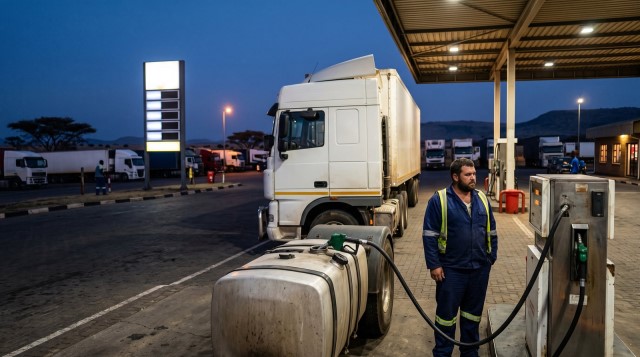
Mid-month data points to a second consecutive diesel price cut in August 2026 -- but the projections have swung violently in a week, and no SADC fleet should be budgeting on them yet.
ECONOMY AND MARKETS
12 July 2026 • 4 min read
July's fuel cut was the biggest break freight operators have had all year. August could bring another -- or it could evaporate. Brent has traded between roughly $72 and $79 a barrel in a single week, and the rand has moved with it.
The Central Energy Fund's running daily average -- the unaudited basis for the monthly price adjustment -- has been pointing to further relief. Early-July projections suggested 95-octane petrol could come down by around R1.62 a litre, with wholesale diesel down by up to R1.61. More optimistic reads through the week put petrol closer to R2.50 a litre lower and wholesale 50ppm diesel as much as R3.51 a litre cheaper.
The spread between those two projections -- roughly R2 a litre on diesel -- is the story. It is not a forecasting failure. It is a live measure of how unstable the two inputs that set the pump price have become.
Where July came from: Brent crude averaged US$86.53 a barrel over the review period, down from US$104.59 -- which, with a firmer rand, delivered a R3.59/litre cut on 50ppm diesel and R3.14/litre on 500ppm from 1 July. (Source: Department of Mineral and Petroleum Resources, 2026)
Renewed geopolitical tension around Iran has driven oil sharply in both directions inside the same trading week. That volatility feeds straight into the rand, which means the currency and the barrel are no longer offsetting each other -- they are amplifying each other. A benign mid-month picture can be wiped out by the final week of the review period, and has been before.
Operators should also remember that the levy structure is now fully loaded. The short-term fuel-levy relief measures have been phased out, with the general fuel levy back at 429c/litre on petrol and 416c/litre on diesel. Whatever the barrel does, that floor is fixed. The slate levy, meanwhile, has been scaled back from 157.74c to 113.94c a litre -- a component that can move against operators just as easily.
The temptation after a large cut is to hold rates and quietly absorb the gain. The temptation after two is to compete the gain away. Both are mistakes. Fuel is 35-55% of road-freight operating cost, and it is set by a barrel price and an exchange rate that no operator on this continent influences. A cut is a windfall, not a new baseline.
Namibian, Botswanan and Zambian operators face the additional lag of national pass-through mechanisms -- relief that reaches the South African pump in early August may only reach theirs weeks later, or be absorbed into a price-stabilisation fund instead. Cross-border operators pricing in rand off South African pump data will get this wrong if they assume the whole region moves together.
Do not price August work off a mid-month projection -- wait for the official announcement in the last week of July before repricing cost-per-km. Make sure your fuel-surcharge clauses adjust in both directions and are triggered by the gazetted price, not a news headline. And bank the July relief into efficiency work -- tyres, maintenance, empty-running reduction -- rather than into a discount you cannot claw back when the barrel turns.
Stay connected with Southern Africa's freight and transport community.
Join 6,400+ logistics professionals across the SADC region.
Visit Laaimylorrie.com| About the Author | |

|
Andre Klynsmith Entrepreneur & Technology Enthusiast Andre's expertise spans technology, blockchain, transport, and logistics -- with a passion for innovation and driving positive change across industries. |
| Source: News24 -- August fuel prices: Midmonth figures are cause for cautious optimism View source › | 10 July 2026 |


Subscribe to our Newsletter and stay in the know with all the latest Industry News, Products and Trends covering the whole of the SADC region.
KS Blockchain T/A Laaimylorrie.com . All Rights Reserved.