Industry related headlines to keep you in the know.
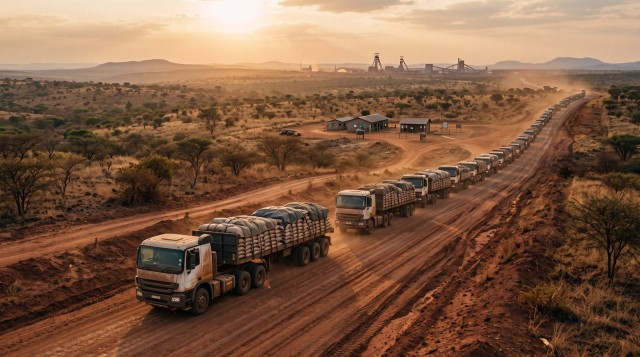
The Democratic Republic of Congo has replaced its outright cobalt export ban with a strict quota system for 2026 — but the harder constraint is not the paperwork in Kinshasa. It is the 3,000 kilometres of road between the Katanga mines and the Port of Durban, and it is already running close to full.
Mining and Commodities
10 July 2026 • 5 min read
The DRC's 2026 cobalt quota is set at 96,600 tonnes, yet actual clearances have been running at a fraction of that pace. When shipments fall short, the reason is increasingly logistical — and that puts SADC transporters at the centre of a global battery-metal story.
After suspending exports to arrest a price collapse, the DRC's minerals regulator ARECOMS moved to a controlled quota regime for 2026, capping the year at 96,600 tonnes — roughly 87,000 tonnes distributed to producers pro rata and the balance held under discretionary control. Producers face firm windows to ship their allocations or forfeit them, with unused volumes rolling into a national strategic reserve rather than carrying over.
That design turns logistics into a race against a clock. A tonne of cobalt hydroxide that cannot physically reach a port in time is not merely delayed revenue — under a use-it-or-lose-it quota, it can become forfeited allocation. The binding question for a miner is no longer only "how much can I export?" but "how much can the corridor actually move before my window closes?"
The gap: Reported clearances over recent months have run at an estimated one-third to one-half of allocated volumes, with administrative bottlenecks, customs delays and corridor capacity all cited as causes. (Source: Fastmarkets / Benchmark Mineral Intelligence, 2026)
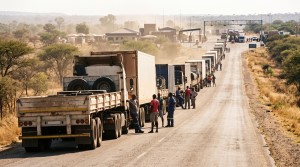
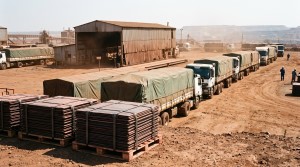
For most of the DRC's battery-metal exports, the working route is still rubber on tar: cobalt hydroxide moves by truck from Katanga to Ndola in Zambia, on to Livingstone, and down through Zimbabwe and South Africa to Durban. It is a corridor measured in thousands of kilometres and multiple border posts, with no rail alternative yet operating at the throughput the tonnages demand.
Analysts describe the route as running near capacity under normal conditions — which means it has little slack to absorb shocks. A single bridge failure, a scanner outage at a busy crossing, or a fuel-supply wobble does not just slow a convoy; it eats into the narrow window a producer has to hit a quota. The much-discussed Lobito rail corridor promises relief to the west over time, but for the volumes moving today, the southern road remains the workhorse.
When export capacity is capped and time-boxed, reliable corridor throughput becomes a premium service, not a commodity one. Dangerous-goods-certified operators, hauliers with proven border-clearance discipline, and transporters who can guarantee turnaround windows are worth more to a miner facing forfeiture than the cheapest available truck. The scarcity has quietly shifted pricing power towards operators who can move volume predictably.
The wider signal for the region is that battery-metal demand will keep leaning on Southern African corridors for years — and that every hour shaved off a Katanga-to-Durban run has a value that now shows up directly in a producer's quota compliance, not just its freight bill.
If you run the Copperbelt-to-Durban corridor, sell reliability, not just capacity — quota deadlines make guaranteed turnaround a premium product. Build documented per-border dwell assumptions into every quote, invest in dangerous-goods compliance, and keep contingency routing ready, because on a corridor running near capacity a single disruption can cost a client a forfeited allocation.
Stay connected with Southern Africa's freight and transport community.
Join 6,400+ logistics professionals across the SADC region.
Visit Laaimylorrie.com| About the Author | |

|
Andre Klynsmith Entrepreneur & Technology Enthusiast Andre's expertise spans technology, blockchain, transport, and logistics — with a passion for innovation and driving positive change across industries. |
| Source: Fastmarkets / Benchmark Mineral Intelligence View source › | 10 July 2026 |


Subscribe to our Newsletter and stay in the know with all the latest Industry News, Products and Trends covering the whole of the SADC region.
KS Blockchain T/A Laaimylorrie.com . All Rights Reserved.