Industry related headlines to keep you in the know.
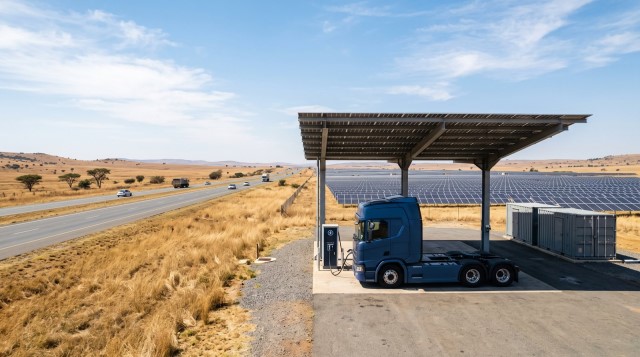
Cape Town-based Zero Carbon Charge is rolling out two fully off-grid, solar-powered ultra-fast charging stations for electric trucks along the N3 corridor between Johannesburg and Durban — South Africa's busiest freight artery — after a pilot proved a heavy-duty electric truck can be fully charged using solar energy alone.
Carbon Footprint
7 July 2026 • 3 min read
The biggest objection to electric trucking in Southern Africa has always been the grid: unreliable, constrained, and nowhere near the highway when you need it. Off-grid solar charging answers that objection head-on — and the first commercial sites are going in on the route that matters most.
The rollout along the 570-kilometre N3 — linking the country's economic hub to its main port — is backed by a US$6.2 million equity investment from the Development Bank of Southern Africa. The funding was conditional on the company building off-grid charging infrastructure every 150 kilometres along national roads, and the two N3 stations were scheduled for completion by June 2026.
Co-founder Joubert Roux says the next phase will target the N1 between Johannesburg and Cape Town, extending ultra-fast off-grid charging across South Africa's main long-distance routes. Each off-grid site costs about US$1.25 million to build.
Proof of concept: In January 2026 Zero Carbon Charge simultaneously charged two SANY heavy-duty electric trucks and four passenger EVs at a fully off-grid, solar-powered site near Wolmaransstad. (Source: Associated Press, 2026)
Heavy-duty electric trucks have faced a double barrier in Southern Africa: enormous energy requirements and a national utility that struggles to meet existing demand. Building grid-tied megawatt charging along highways would add load exactly where the network is weakest. By pairing solar generation with battery storage, off-grid hubs sidestep the constraint entirely.
"Our approach is to build energy-resilient charging hubs that are not dependent on an unstable grid," Roux says. "By combining solar and storage, we can provide predictable, clean power for fleets." The model follows global pioneers such as WattEV in California and Milence in Europe — but the off-grid design is arguably better suited to African conditions than either.
Roux is frank about the risks: regulatory delays on site approvals, high import duties on electric trucks, certification requirements and limited vehicle availability all slow adoption. Electric truck sales globally passed 90,000 units in 2024, but more than 80% of those were in China — Southern African fleets are still early on the curve.
Still, the direction is set. Shippers under pressure from customers and export markets to cut logistics emissions now have a corridor where electric line-haul is becoming physically possible — and infrastructure tends to unlock demand that was invisible while it did not exist.
Electric line-haul on the N3 is moving from theory to infrastructure. Operators do not need to buy e-trucks tomorrow, but they should start modelling total cost of ownership on the Johannesburg–Durban lane, watch which customers begin specifying low-emission transport in tenders, and track charging coverage as it extends to the N1.
Stay connected with Southern Africa's freight and transport community.
Join 6,400+ logistics professionals across the SADC region.
Visit Laaimylorrie.com| About the Author | |

|
Andre Klynsmith Entrepreneur & Technology Enthusiast Andre's expertise spans technology, blockchain, transport, and logistics -- with a passion for innovation and driving positive change across industries. |
| Source: Associated Press View source › | 26 February 2026 |


Subscribe to our Newsletter and stay in the know with all the latest Industry News, Products and Trends covering the whole of the SADC region.
KS Blockchain T/A Laaimylorrie.com . All Rights Reserved.