Industry related headlines to keep you in the know.
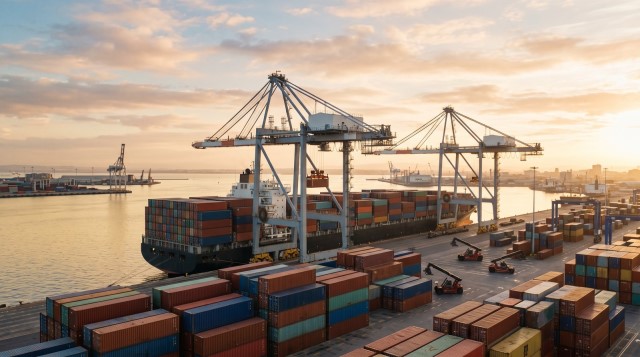
Ocean freight rates are climbing again. Drewry's World Container Index rose roughly 3% to about US$2,800 per 40ft container in late May 2026 — a fourth consecutive weekly increase — defying earlier forecasts that 2026 would be a year of falling rates. For SADC importers and exporters who budgeted on softer pricing, the message is clear: plan for a firmer ocean freight market through the second half of the year.
Shipping and Logistics
23 June 2026 • 3 min read
The "rates will fall in 2026" story has stalled. With demand up 4% year to date and carriers leaning on surcharges and blank sailings, SADC shippers face a firmer-than-expected freight market — and landed-cost plans built on cheaper shipping now need a rethink.
Coming into 2026, much of the industry expected new vessel deliveries to flood the market with capacity and pull rates down. Instead, global ocean demand has risen about 4% year to date, driven by strong volumes out of Asia, and benchmark rates have ticked up for several weeks running. Asia-Europe and Transpacific lanes have both firmed, with carriers holding the line through higher FAK levels, peak-season surcharges and blank sailings that quietly remove capacity when demand softens.
Bunker prices remain elevated too, feeding fuel surcharges on top of base rates. For SADC cargo owners, the practical effect is that the all-in cost of moving a box is drifting upward at exactly the point in the year — the mid-year peak season — when capacity is tightest.
Where rates sit: Drewry's World Container Index rose ~3% to about US$2,800 per 40ft container on 28 May 2026, a fourth straight weekly increase. (Source: Drewry / Freight News, 2026)
SADC shippers also carry costs that don't show up on a global index. South African border crossing times recently lengthened to around 10.4 hours, even as the wider SADC regional average improved to roughly 5.9 hours. At the ports, congestion data has flagged Coega as the main watch point at about four days, with Durban and Port Elizabeth near two days and Cape Town around one.
Add the Cape route reality — with Red Sea transits still fragile, many services continue routing around southern Africa, tying up vessels and equipment for longer — and the effective cost and transit time for a SADC import or export sits above the headline number.
The operators who weather this best treat freight as a managed cost, not a market they hope turns in their favour. That means revisiting landed-cost models on the assumption that rates stay firm into late 2026, factoring peak-season and bunker surcharges into quotes rather than absorbing them, and where volumes justify it, securing contract rates with capacity commitments instead of relying on the spot market.
It also means building a time buffer for the border and port delays that are specific to this region, so a tighter shipping market doesn't translate into missed onward connections inland.
Budget on a firm — not falling — ocean market for the rest of 2026. Lock in rate and capacity agreements where you can, build surcharges and the Southern Africa delay premium explicitly into landed cost, and keep a transit buffer so peak-season tightness doesn't cascade into your inland legs.
Stay connected with Southern Africa's freight and transport community.
Join 6,400+ logistics professionals across the SADC region.
Visit Laaimylorrie.com| About the Author | |

|
Andre Klynsmith Entrepreneur & Technology Enthusiast Andre's expertise spans technology, blockchain, transport, and logistics -- with a passion for innovation and driving positive change across industries. |
| Source: Freight News / Drewry World Container Index View source › | 23 June 2026 |


Subscribe to our Newsletter and stay in the know with all the latest Industry News, Products and Trends covering the whole of the SADC region.
KS Blockchain T/A Laaimylorrie.com . All Rights Reserved.