Industry related headlines to keep you in the know.
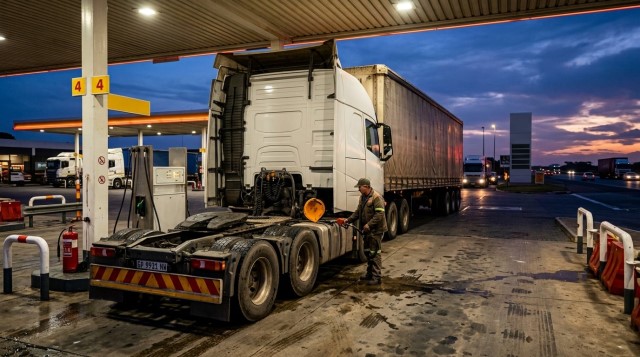
The last slice of South Africa's temporary fuel-levy relief falls away on 1 July 2026, returning the general fuel levy to its full baseline of R4.10 per litre on petrol and R3.93 per litre on diesel. For freight operators, a tax-driven cost step is now locked into the third quarter — and it is time to price it in.
Economy and Markets
18 June 2026 • 5 min read
National Treasury has confirmed that the remaining temporary fuel-levy relief expires on 1 July 2026, pushing the general fuel levy back to R4.10 a litre on petrol and R3.93 on diesel. Unlike an oil-price swing, this is a fixed tax increase operators can see coming — which means there is no excuse for it to surprise a single freight rate.
Earlier in 2026, Treasury introduced temporary relief on the general fuel levy to cushion motorists and businesses against geopolitically driven fuel prices. That relief is being withdrawn in stages, and the final portion ends on 1 July. From that date, the levy returns to its full baseline rate — R4.10 per litre on petrol and R3.93 per litre on diesel — with Treasury signalling that a further extension is unlikely.
The levy is a fixed tax: it does not move with the oil price or the rand. That makes it different from the monthly fuel-price adjustment, and it makes the July step-up entirely predictable. Whatever the basic fuel price does, the tax component is going up.
Why it bites: Diesel typically accounts for more than 40% of a road-freight operator's running costs, so a fixed levy increase flows almost directly to the bottom line. (Source: Road Freight Association / National Treasury, 2026)
The reset lands on top of an already volatile few months at the pump. June brought some relief on the underlying diesel price as international product costs softened, even as petrol moved the other way. The 1 July levy step-up risks clawing back part of that diesel relief, leaving the net cost trajectory for the quarter looking flat to higher rather than improving.
Because South African pump prices set the benchmark for haulage rates across much of the region, the effect is not confined to domestic operators. Cross-border hauliers refuelling in or pricing against South Africa feel the same squeeze on the long SADC corridors.
Run the numbers now. Recalculate your cost-per-kilometre using the post-1-July levy, and check that fuel surcharge clauses in customer contracts are current and actually trigger on a tax change, not only on the basic fuel price. Where rates are fixed, decide whether to absorb, renegotiate or hedge the difference — and have that conversation with customers before the increase lands, not after.
This is also a prompt to attack the controllable side of the fuel bill: route optimisation, idling and driving-behaviour management, and tackling fuel theft, which continues to drain margins across the industry. A predictable tax increase is precisely the kind of cost a well-run fleet plans around rather than reacts to.
The 1 July levy reset is a known, fixed cost increase — treat it as a planning event, not a shock. Reprice cost-per-kilometre against the new baseline, confirm your fuel surcharge clauses respond to tax changes, and lock in customer conversations before month-end so the increase does not quietly erode Q3 margins.
Stay connected with Southern Africa's freight and transport community.
Join 6,400+ logistics professionals across the SADC region.
Visit Laaimylorrie.com| About the Author | |

|
Andre Klynsmith Entrepreneur & Technology Enthusiast Andre's expertise spans technology, blockchain, transport, and logistics — with a passion for innovation and driving positive change across industries. |
| Source: National Treasury / AutoTrader View source › | 18 June 2026 |


Subscribe to our Newsletter and stay in the know with all the latest Industry News, Products and Trends covering the whole of the SADC region.
KS Blockchain T/A Laaimylorrie.com . All Rights Reserved.