Industry related headlines to keep you in the know.
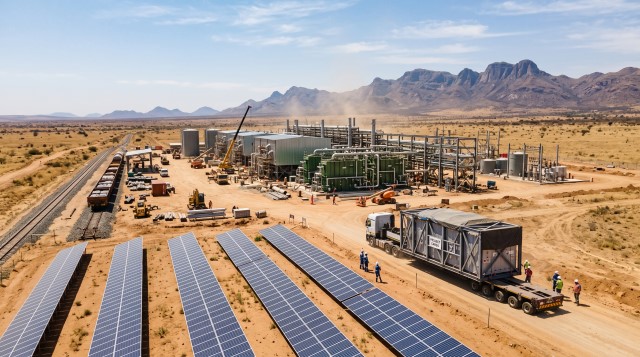
South Africa's Prieska Power Reserve will start producing green hydrogen and ammonia in 2026, just as Namibia's Hyphen project closes in on its Final Investment Decision and Transnet secures EU grant funding for hydrogen-ready rail and port infrastructure. For SADC freight operators, the decarbonisation conversation is shifting from theory to procurement.
Carbon Footprint
29 May 2026 • 5 min read
Green hydrogen has stopped being a 2030 conversation and become a 2026 procurement decision. With Prieska going live, Hyphen approaching FID, and EU grants flowing into Transnet, SADC freight operators need to understand where the first decarbonised freight lanes will actually appear — and how to position to serve them.
The Prieska Power Reserve in South Africa's Northern Cape is on schedule to start producing green hydrogen and green ammonia in 2026, supported by approximately $35 million in EU grant funding tied to wider South Africa green hydrogen value chain commitments. Parallel to Prieska, the Renewstable Mpumalanga (RMPU) projects are expected to come online from the end of 2026, anchored around coal-region just-transition objectives and tied into Transnet's hydrogen-ready freight rail planning.
In Namibia, the Hyphen Hydrogen Energy project in the Tsau Khaeb area continues to advance toward Final Investment Decision in late 2026, with first commercial production targeted for the 2029–2030 window. Alongside Hyphen, the Lüderitz port expansion has been re-scoped explicitly as a hydrogen export terminal, and the Walvis Bay channel deepening project is positioning the northern port to handle ammonia carriers and platform supply vessels for the offshore oil and gas industry from 2027.
EU grant support: Approximately $35 million in EU grants is flowing into South African green hydrogen — including direct support for Transnet rail, port, pipeline and logistics infrastructure. (Source: Green Hydrogen Organisation / European Commission, 2026)
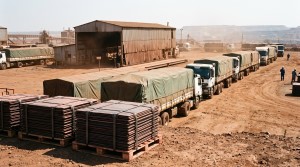
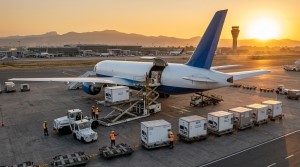
Green hydrogen at scale unlocks three SADC freight lanes that did not previously exist. The first is project cargo into the construction sites — abnormal loads, electrolyser modules, wind blades, solar arrays and EPC equipment moving through Walvis Bay, Lüderitz, Cape Town and Saldanha. The second is the ongoing operating supply chain — reagents, spares, catalysts and consumables — that follows the construction phase. The third, and most consequential, is the export logistics for green ammonia and methanol, which will reshape how Cape Town and Walvis Bay function as bunkering and energy export hubs by 2028.
Parallel to the export story, hydrogen and fuel-cell trucking pilots are gaining traction along the South Africa Hydrogen Valley corridor between Limpopo and Durban. While fleet-scale fuel-cell trucking remains a 2028–2030 proposition, the early 2026 pilots are setting the regulatory, fuelling and maintenance benchmarks that operators will inherit. SADC operators that begin engaging with OEMs and pilot consortia now will be the ones positioned to bid for early decarbonised freight contracts.
Multinational customers — particularly automotive, FMCG, mining and pharmaceutical principals with Scope 3 commitments — are starting to embed measurable carbon-intensity thresholds into 2026 freight tenders. The GLEC Framework for emissions reporting is now appearing as a tender prerequisite at the larger 3PL and asset-heavy carrier level, and several SADC operators are quietly preparing first-time emissions baselines to qualify.
Combined with the EU Carbon Border Adjustment Mechanism (CBAM) entering full effect in 2026 for the in-scope SADC mineral and metal exports, the procurement pressure is no longer optional. SADC freight operators that can credibly document fleet emissions, fuel-quality data, telematics-derived efficiency scores and route-level carbon performance are increasingly winning over operators that cannot. Green hydrogen is the long-run story; emissions-credible operations are the right-now story.
Build emissions reporting capability into your 2026 operations — GLEC-aligned baselines, telematics-linked fuel data, and route-level carbon scoring. Position now for hydrogen-related project cargo into Walvis Bay, Lüderitz and the Northern Cape, and engage early with fuel-cell trucking pilots on the SA Hydrogen Valley corridor.
Stay connected with Southern Africa's freight and transport community.
Join 6,400+ logistics professionals across the SADC region.
Visit Laaimylorrie.com| About the Author | |

|
Andre Klynsmith Entrepreneur & Technology Enthusiast Andre's expertise spans technology, blockchain, transport, and logistics — with a passion for innovation and driving positive change across industries. |
| Source: Green Hydrogen Organisation / Afripoli / European Commission View source › | 29 May 2026 |


Subscribe to our Newsletter and stay in the know with all the latest Industry News, Products and Trends covering the whole of the SADC region.
KS Blockchain T/A Laaimylorrie.com . All Rights Reserved.