Industry related headlines to keep you in the know.
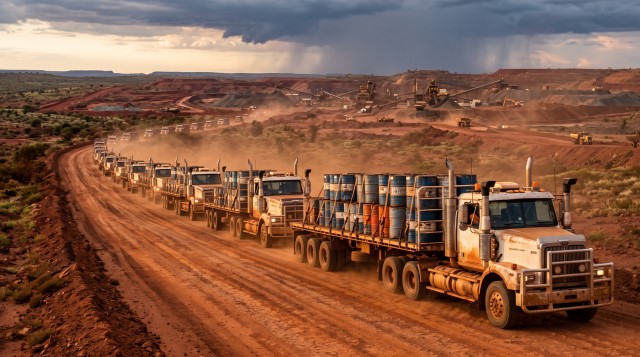
Cobalt has rallied past $56,000 per metric tonne and Zambia is on track to ship more than one million tonnes of copper in 2026 — but the logistics chain that has to move those minerals to port is showing visible strain. The mineral price story of 2026 is now a SADC logistics story.
Mining and Commodities
29 May 2026 • 5 min read
When cobalt sits at multi-year highs and Copperbelt output crosses a million tonnes, every kilometre of corridor — Lobito, North-South, Beira, Walvis Bay — gets repriced. The 2026 mineral squeeze is a freight squeeze, and SADC operators need to plan capacity differently.
Cobalt metal entered 2026 at roughly $56,414 per tonne and has held at levels not seen since July 2022. The DRC's export cap on cobalt — designed to support prices in the face of weakening EV demand — has done its job and then some. On the copper side, prices briefly broke $14,500 per tonne in January 2026 before settling around $13,000 by mid-April, with the International Copper Study Group now forecasting a refined market deficit of 150,000 tonnes for the year.
These price levels matter because they make every additional tonne of mined output economically worth shipping — and they pull forward investment decisions that would otherwise have stayed on hold. Zambia's finance ministry now expects national copper production to exceed one million tonnes in 2026 and rise to 1.2 million tonnes in 2027, supported by major investments from First Quantum, CMOC, Barrick and Zijin Mining. That is a step-change in volume that the existing corridor network was not designed for.
Copperbelt step-up: Zambia's copper output is projected at >1.0 million tonnes in 2026 and 1.2 million tonnes in 2027 — roughly +50% over a three-year window. (Source: Zambia Ministry of Finance / The Africa Report, 2026)
SADC has four credible mineral corridor options — North-South via Durban, Walvis Bay via the Trans-Caprivi, Beira/Nacala for central-eastern routing, and Lobito via Angola — and all four are now actively bidding for tonnage. The Lobito Corridor moved into full delivery mode through May 2026 as nine EPC contractors submitted bids on the Zambia greenfield section, with construction expected to break ground later this year. Lobito's eventual promise is to compress Copperbelt-to-sea transit from over a month to roughly a week.
But until Lobito's Zambia greenfield section is operational, the burden falls almost entirely on the existing North-South road corridor and on Walvis Bay's western route. The result has been visible: border delays at Kasumbalesa and Chirundu, congestion build-up around Lubumbashi, and tight bookings at Walvis Bay's container terminal. Sulphuric acid shortages out of Zambia into the DRC — the subject of new permit-based export controls — have added a further volatility layer that mining transporters now have to price in.
The operators who will benefit most are those treating 2026 as a positioning window for 2027–2030. Three behaviours stand out. First, securing multi-corridor capability — a fleet that can rotate between North-South and Trans-Caprivi corridors keeps options open. Second, locking in sulphuric acid and reagent backhaul lanes, where margins are now structurally higher than empty returns. Third, building early relationships with Lobito Atlantic Railway, TransNamib and Zambia Railways operations teams before commissioning compresses the queue.
On the asset side, the maths is shifting too. With cobalt at multi-year highs and copper in structural deficit, mining houses are accepting longer-term offtake-linked freight contracts that bake in fuel adjustment, currency cover and minimum-volume floors. SADC fleet operators who can demonstrate audit-grade tracking, RTMS-style compliance and cross-border permit depth are winning these contracts at margins that road freight has not seen since 2022.
Mineral price strength is converting into structural freight demand. Plan now for multi-corridor capability, lock in backhaul reagent flows where possible, and invest in compliance documentation that lets you compete for the long-term mining offtake-linked contracts that are becoming the dominant 2026–2027 trade.
Stay connected with Southern Africa's freight and transport community.
Join 6,400+ logistics professionals across the SADC region.
Visit Laaimylorrie.com| About the Author | |

|
Andre Klynsmith Entrepreneur & Technology Enthusiast Andre's expertise spans technology, blockchain, transport, and logistics — with a passion for innovation and driving positive change across industries. |
| Source: S&P Global / International Banker / The Africa Report View source › | 29 May 2026 |


Subscribe to our Newsletter and stay in the know with all the latest Industry News, Products and Trends covering the whole of the SADC region.
KS Blockchain T/A Laaimylorrie.com . All Rights Reserved.