Industry related headlines to keep you in the know.
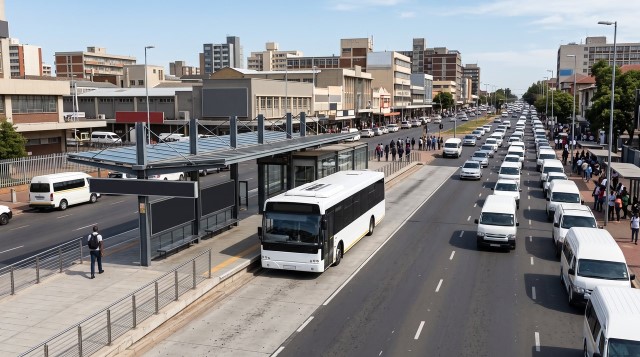
South Africa's Department of Transport has confirmed it will phase out funding for the country's bus rapid transit network, ending a two-decade experiment that absorbed more than R80 billion of public money.
Public Transport
25 May 2026 • 4 min read
In mid-May 2026, the Department of Transport announced it is effectively pulling the plug on South Africa's BRT programme, redirecting grants into a new consolidated road-based public transport fund. With only around 152,000 daily BRT passengers against roughly 8 million road-based commuters, the move is a frank admission that the model never reached scale — and it reshapes how SADC cities should think about urban mobility.
Bus rapid transit arrived in South Africa with strong ambitions. Systems such as Johannesburg's Rea Vaya, Cape Town's MyCiTi and Tshwane's A Re Yeng were meant to deliver dedicated-lane, high-frequency corridors that would draw commuters off congested roads. Two decades and more than R80 billion later, the Department of Transport says the network failed to attract the ridership it was built for.
The scale of the gap is stark. Roughly 152,000 passengers use BRT services nationwide each day, against an estimated 8 million who travel by minibus taxi and other road-based transport. Rea Vaya — operating more than 200 buses across 63 stations in Johannesburg — carries only an estimated 15,000 to 20,000 people daily. For an asset base of that size, those are loads a commercial operator could not sustain.
The scale gap: About 152,000 commuters use BRT nationally each day, compared with roughly 8 million who rely on minibus taxis and other road-based transport — after more than R80 billion in BRT investment. (Source: Daily Investor / Department of Transport, 2026)
Rather than continuing to subsidise underused trunk corridors, the Department says grants for the current BRT programme will be phased out in favour of a new road-based public transport fund. The fund is intended to consolidate support for existing bus and minibus services under a single umbrella, and is being drafted for public consultation. In effect, the state is choosing to back the transport that commuters already use rather than the system it hoped they would adopt.
The transition is not without friction. Taxi operators have said they learned of the funding cuts through the media and were not consulted, and cities with partly built systems — including Rustenburg's Yarona network — now face uncertainty over expansion plans. How the new fund treats the minibus taxi industry, which moves the overwhelming majority of South African commuters, will determine whether the pivot succeeds or simply shifts the problem.
Urban mobility policy rarely makes freight headlines, but it shapes the roads that delivery vehicles share. Congestion in metros directly affects last-mile distribution costs, delivery windows and driver productivity. A public transport strategy that finally works with the dominant minibus mode, instead of against it, could ease pressure on the corridors that urban freight depends on.
For the wider SADC region, the lesson is sobering. Several cities have studied or piloted BRT-style projects, often with donor backing. South Africa's experience is a clear signal that imported corridor models do not automatically fit African commuting patterns — and that mobility planning must start from how people actually travel today.
Urban distribution operators should watch how the new road-based fund reshapes metro traffic and minibus operations, since both feed directly into last-mile costs and delivery windows. For SADC cities considering BRT-style projects, South Africa's R80 billion lesson argues for mobility plans built around existing minibus and bus networks rather than imported trunk-corridor models.
Stay connected with Southern Africa's freight and transport community.
Join 6,400+ logistics professionals across the SADC region.
Visit Laaimylorrie.com| About the Author | |

|
Andre Klynsmith Entrepreneur & Technology Enthusiast Andre's expertise spans technology, blockchain, transport, and logistics — with a passion for innovation and driving positive change across industries. |
| Source: Daily Investor — South Africa's Department of Transport View source › | 25 May 2026 |


Subscribe to our Newsletter and stay in the know with all the latest Industry News, Products and Trends covering the whole of the SADC region.
KS Blockchain T/A Laaimylorrie.com . All Rights Reserved.