Industry related headlines to keep you in the know.
Two of SADC's largest commuter taxi markets raised fares within days of each other in mid-May 2026: South Africa's National Taxi Council (Santaco) approved local fare increases of R2 to R6 and long-distance increases of R10 to R30, while Namibia's Road Transportation Board enforced a 15 percent minimum fare adjustment across taxi and bus services from 18 May 2026.
Public Transport
20 May 2026 • 5 min read
When 15 million daily taxi commuters in South Africa and almost every Namibian bus passenger absorb the same fuel shock in the same week, the freight industry is looking at the most reliable early warning indicator it has -- and it is flashing amber.
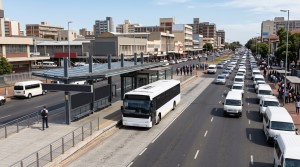
South Africa's Santaco approved a fresh round of taxi fare increases in mid-May 2026, with local trip prices rising R2 to R6 and long-distance routes increasing by between R10 and R30 depending on origin, destination and operator cost structure. The decision followed a sustained spike in fuel prices since February 2026, when geopolitical tension drove the 93 unleaded petrol price up by R6.53 per litre and diesel by an equivalent margin. Roughly 15 million people use minibus taxis daily in South Africa, making the increase the most widely felt cost shock of the year so far.
Namibia followed within the same window. The Road Transportation Board recommended and enforced a 15 percent minimum fare adjustment across taxi and bus services nationwide, effective 18 May 2026. In Windhoek, that translated into an immediate move from N$13 to N$15 for the standard taxi trip, with longer regional routes pricing well above that. The Board's decision was framed explicitly as a response to operator cost pressure rather than a discretionary adjustment.
By the numbers: R2-R6 local and R10-R30 long-distance Santaco increases in South Africa, a 15 percent minimum bus and taxi fare adjustment in Namibia, against a R6.53 per litre rise in SA petrol since February 2026. (Source: Daily Maverick, Informanté, May 2026)
The minibus taxi industry runs on the same diesel and petrol prices as commercial freight, on similar routes, and with cost structures that pass through faster than any contracted haulier rate. When Santaco moves, it is signalling that the operator base can no longer absorb the input cost change with informal cross-subsidy. When Namibia's regulator forces a sector-wide increase, it is acknowledging that the operating model has reached margin compression that the public sector cannot ignore.
Commercial freight operators in SADC sit one step further down the visibility chain. Long-haul road hauliers between Johannesburg and Lusaka, or between Windhoek and the Copperbelt, will face the same diesel cost wave but typically have to wait for the next contract review cycle to pass through. That gap -- between when fuel prices move and when contract rates catch up -- is where margin erosion historically happens fastest. The May 2026 commuter fare moves should be treated as the leading public signal that hauliers need to bring forward their next rate adjustment conversation with shippers.
The South African fuel levy temporary relief is scheduled to unwind from 1 July 2026, which means another structural fuel price increase is loaded into the pipeline -- on top of the international price-driven moves that triggered the Santaco and Namibian Board adjustments. If commuter operators are already raising fares in May to recover prior cost shocks, the second wave landing in July will compress sector margins further and almost certainly produce a second round of public transport fare increases by Q3 2026.
For freight forwarders and shippers, the operational consequence is twofold. First, fuel surcharges on commercial road freight contracts should be reviewed and re-indexed against the actual pump price, not last year's reference month. Second, public transport fare protests historically follow back-to-back increases by six to ten weeks, which is a real operational risk to delivery schedules in metropolitan centres including Johannesburg, Cape Town, Pretoria and Windhoek.
Treat May 2026's commuter fare moves as the first wave of a two-wave fuel cost story. Bring forward freight surcharge and rate review conversations with key shippers before the 1 July fuel levy restoration, and build a contingency window into delivery schedules in major urban centres for fare-protest-related disruption in Q3 2026.
Stay connected with Southern Africa's freight and transport community.
Join 6,400+ logistics professionals across the SADC region.
Visit Laaimylorrie.com| About the Author | |

|
Andre Klynsmith Entrepreneur & Technology Enthusiast Andre's expertise spans technology, blockchain, transport, and logistics -- with a passion for innovation and driving positive change across industries. |
| Source: Daily Maverick -- "SA commuters cut back on groceries as taxi fares rise, drivers plead for subsidies" View source › | 19 May 2026 |


Subscribe to our Newsletter and stay in the know with all the latest Industry News, Products and Trends covering the whole of the SADC region.
KS Blockchain T/A Laaimylorrie.com . All Rights Reserved.