Industry related headlines to keep you in the know.
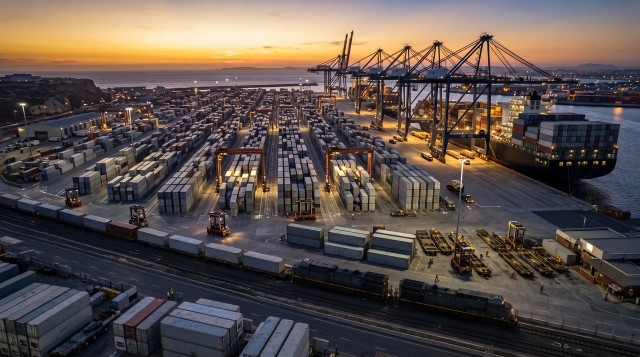
France's development agency AFD has signed a EUR 300 million (approximately R5.8 billion) sustainability-linked loan with Transnet to bankroll the rehabilitation of 550 kilometres of rail along South Africa's Cape and Container corridors and accelerate a shift of freight off road and onto lower-carbon rail.
Shipping and Logistics
20 May 2026 • 5 min read
This is not a normal infrastructure loan. Transnet only draws the money if it hits a series of pre-agreed sustainability milestones, which means SADC freight forwarders, exporters and road hauliers can now read the deal as a credible signal that rail volumes on the Cape and Container corridors will start to recover from 2026 onward.
The EUR 300 million facility, announced on 4 May 2026 and confirmed by AFD, the European Union and Transnet jointly, forms part of France's broader EUR 1 billion commitment to South Africa's Just Energy Transition Partnership (JETP) first made at COP26. Unlike a traditional project bond ring-fenced to a single asset, the AFD loan is structured as a sustainability-linked facility -- Transnet has flexibility to deploy proceeds across the agreed Freight Decarbonisation and Corporate Sustainability Programme, but disbursement is conditional on meeting mutually agreed environmental and operational milestones.
For freight operators, that distinction matters. Sustainability-linked loans force the borrower to commit to measurable outcomes -- in this case, tonne-kilometre growth on rehabilitated corridors, megawatts of renewable energy procured and a defined operational carbon trajectory. Missed milestones come with financial penalties baked into the loan margin, giving Transnet a direct cash incentive to actually deliver volume recovery on the lines hauliers and shippers depend on.
The headline numbers: EUR 300 million loan, 550 km of rail rehabilitation across the Cape and Container corridors, 30 MW of renewable energy procurement, and a structural shift of freight from road onto lower-carbon rail. (Source: AFD, May 2026)
The Programme's stated priorities mirror the operational gaps SADC shippers have complained about for years. First, 550 kilometres of rail along the Cape and Container corridors -- the spines that link the Western Cape and Gauteng into Durban, Coega and the City Deep dry port -- will be rehabilitated. Second, Transnet will procure 30 MW of renewable energy to insulate operations from Eskom volatility. Third, the utility will diversify its business mix away from coal volumes toward green hydrogen, transition minerals and renewable-energy supply chains.
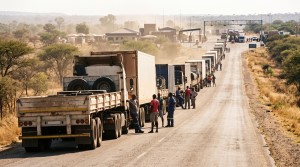
The corridor focus is what should catch SADC operators' attention. The Container Corridor (Johannesburg-Durban) handles the bulk of containerised import-export volumes for landlocked SADC neighbours -- Zimbabwe, Zambia, the DRC and Botswana. The Cape Corridor underpins agricultural and citrus exports out of Cape Town and Coega. Reliable rail on both lines reduces the road truck pressure that has driven Beitbridge and Kasumbalesa congestion higher in 2025 and early 2026.
The honest answer is that modal shift has been promised in every Transnet recovery plan since 2018, with limited delivery. What is different this time is the combination of three reinforcing pressures. The first is the AFD loan itself, which puts external lender milestones onto Transnet's corporate scorecard. The second is the cabinet-approved National Rail Master Plan (NRMP) published for public comment on 1 April 2026, which sets a framework for private operator access on the network. The third is the 1 July 2026 fuel levy restoration in South Africa, which is expected to push road freight rates higher and improve rail's relative cost position on long-haul flows.
If even half the planned tonne-kilometre recovery materialises on the Cape and Container corridors over the next 24 months, road hauliers running between Johannesburg and Durban or Cape Town will face genuine intermodal competition on long-haul, mass-friendly cargoes -- minerals, paper, citrus, automotive. Freight forwarders need to start modelling rail back into their service mix rather than treating it, as many have since 2020, as a residual option.
Sustainability-linked loans tied to corridor performance change the incentives for Transnet in a way that internal recovery plans never have. Freight forwarders should request fresh rail tariff and slot indications for Cape and Container corridor flows over the next six months; road hauliers running long-haul mineral, citrus or automotive volumes should pressure-test their 2027 rate cards against a credible rail recovery scenario.
Stay connected with Southern Africa's freight and transport community.
Join 6,400+ logistics professionals across the SADC region.
Visit Laaimylorrie.com| About the Author | |

|
Andre Klynsmith Entrepreneur & Technology Enthusiast Andre's expertise spans technology, blockchain, transport, and logistics -- with a passion for innovation and driving positive change across industries. |
| Source: Engineering News -- "EUR 300m AFD loan to assist Transnet's transition to low-carbon operating model" View source › | 4 May 2026 |


Subscribe to our Newsletter and stay in the know with all the latest Industry News, Products and Trends covering the whole of the SADC region.
KS Blockchain T/A Laaimylorrie.com . All Rights Reserved.