Industry related headlines to keep you in the know.
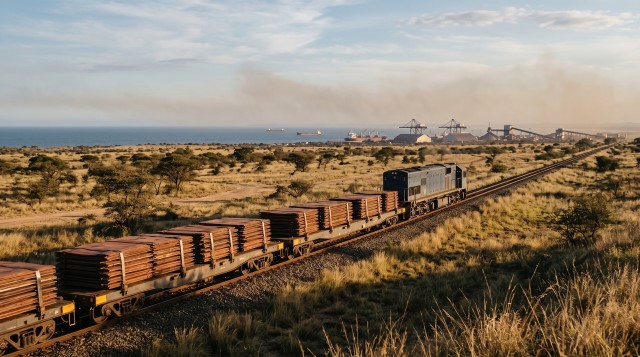
The Lobito Atlantic Railway consortium has confirmed implementation milestones on the combined US$753 million debt package from the US International Development Finance Corporation (DFC) and the Development Bank of Southern Africa (DBSA), the cornerstone financing for a railway that promises to lift transport capacity 10-fold and cut copper and cobalt freight costs by up to 30% out of the SADC mineral belt.
Mining and Commodities
15 May 2026 • 5 min read
A US$553 million DFC loan and a US$200 million DBSA loan are now flowing into the 1,300-kilometre Benguela line and the Lobito mineral port. The build-out — combined with new Zambian and DRC connector segments — gives SADC operators a viable Atlantic corridor option for the first time in a generation.
The combined US$753 million package — US$553 million from the DFC and US$200 million from the DBSA — was formalised in late 2025 and is now in active drawdown as the Lobito Atlantic Railway consortium accelerates rehabilitation of the Angolan port of Lobito and the 1,300-kilometre Benguela line that runs from the Atlantic coast to Luau on the DRC border. The financing is one of the largest US-backed mineral logistics investments on the African continent and is structured to support a 30-year concession that the Trump administration has continued from the Biden-era policy framework.
The strategic ambition is straightforward. The Benguela line, once rehabilitated and re-equipped, is expected to lift mineral haulage capacity by roughly a factor of 10 and to compress per-tonne transport costs by up to 30% versus current southern routings through Durban, Beira and Nacala. For SADC operators moving copper, cobalt, manganese and ferro-alloys from the Copperbelt to global markets, that translates into a new pricing benchmark for inland-to-port haulage that every existing corridor will have to respond to.
Headline numbers: US$553m DFC + US$200m DBSA = US$753m. 1,300 km of Angolan main line, 515 km of new Zambian connector, 315 km of new DRC connector. Capacity uplift: ~10x. Transport cost reduction: up to 30%. (Source: DFC / Atlantic Council, 2025/2026)
Ivanhoe Mines' Kamoa-Kakula complex has already shipped over 10,000 tonnes of copper concentrate via the new corridor, reportedly cutting in-bound distances by roughly 66% versus the long-running southern routes that haul DRC copper through Lusaka and on to Durban or Beira. Zambia's finance ministry expects national copper production to exceed one million tonnes in 2026 and 1.2 million tonnes in 2027 — volumes that the existing southern corridor truck capacity is already struggling to absorb during peak months.
For SADC freight operators, the corridor's emergence is more than a copper story. The same rail system is being engineered to move agricultural exports, fertiliser imports, fuel and project cargo, and the financing package is explicitly structured to anchor multimodal links into Namibia's Walvis Bay corridor and onward to Zambia. The strategic logic is to give the Copperbelt two competing oceans rather than one — and to give shippers route optionality they have not had since the original Benguela line collapsed in the 1970s and 1980s.
Capacity uplift on a brownfield African rail line is never a straight-line forecast. The Benguela line is being re-rehabilitated against decades of underinvestment, and the Zambian and DRC connector segments remain at the planning stage. Recent DRC reporting also flagged a "massive" discrepancy between artisanal cobalt hydroxide exports and the formal quota system, while a bridge collapse and customs disruption have already slowed early 2026 export shipments — reminders that infrastructure financing is necessary but not sufficient.
Even so, the trajectory is clear. With EPC bids active, the AFC fundraising cycle moving into Q3 2026, financial close targeted for Q4 2027 and full completion penciled for 2030, SADC mining freight operators have a four-to-six-year window to position fleet investment, warehousing footprint and customs capability for a corridor that will reshape the geography of Southern African mineral exports.
Mineral hauliers serving DRC and Zambian shippers should already be modelling Lobito as a real route option on every tender, building bonded warehousing presence in northern Zambia and the Angolan border zone, and pricing the eventual 30% transport-cost compression into multi-year contract negotiations. Hauliers that wait until the corridor is fully operational will be competing for residual volume at the bottom of the rate cycle.
Stay connected with Southern Africa's freight and transport community.
Join 6,400+ logistics professionals across the SADC region.
Visit Laaimylorrie.com| About the Author | |

|
Andre Klynsmith Entrepreneur & Technology Enthusiast Andre's expertise spans technology, blockchain, transport, and logistics -- with a passion for innovation and driving positive change across industries. |
| Source: US DFC / Club of Mozambique / Atlantic Council View source › | 14 May 2026 |


Subscribe to our Newsletter and stay in the know with all the latest Industry News, Products and Trends covering the whole of the SADC region.
KS Blockchain T/A Laaimylorrie.com . All Rights Reserved.