Industry related headlines to keep you in the know.
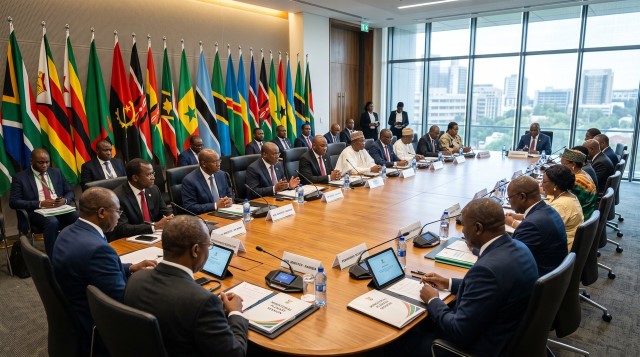
The African Union Commission convened the 5th Ordinary Session of the Specialised Technical Committee on Transport and Energy in Johannesburg from 27 to 30 April 2026 under the theme "The Africa We Build: Transport and Energy as Catalysts for Africa's Prosperity" — placing road corridor digitalisation, transport decarbonisation and cross-border logistics harmonisation squarely on the continental agenda.
TECHNOLOGY AND TRENDS
8 May 2026 • 4 min read
AU ministers and senior officials closed the four-day Johannesburg session with three priorities for the continent's freight ecosystem: corridor digitalisation, transport decarbonisation and cross-border harmonisation. For SADC operators, the summit is the policy umbrella under which the SADC Digital Waybill, CTMS pre-clearance and CBRTA Cross-Easy Permit work all sit — and it sets a clearer execution clock than any single national reform.
The 5th STC brought together AU ministers responsible for transport, energy and ICT, alongside the African Union Commission, AfCFTA Secretariat, AfDB, UNECA and regional economic communities including SADC, COMESA, ECOWAS and EAC. The four-day work programme covered the Programme for Infrastructure Development in Africa (PIDA) progress review, alignment of national transport master plans with the AU Agenda 2063 framework, and a dedicated session on digital corridor reform — a continuation of the AU's 2024-2026 push to put cross-border data exchange on a single, interoperable backbone.
Three workstreams emerged with the clearest delivery focus. The first is digital corridors — the integration of customs, immigration and port-health systems across regional economic communities, building on AfCFTA's customs platform and SADC's Corridor Trip Monitoring System. The second is transport decarbonisation — alignment of national emissions reporting frameworks with the GLEC Framework, ISO 14083 and EU CBAM expectations. The third is corridor financing and PPP frameworks — coordinated approaches across PIDA priority projects so that no individual national tender process becomes a single point of failure.
5th STC Transport & Energy: Johannesburg, 27-30 April 2026. Theme: "The Africa We Build". Outputs: digital corridors, transport decarbonisation, corridor PPP financing alignment. (Source: AU Commission STC Transport & Energy 2026)
SADC's existing reform stack maps cleanly onto the AU's three priority workstreams. The SADC Digital Waybill and CTMS pre-clearance system, expanded through Q1 and Q2 2026, fit directly inside the AU's digital corridors agenda. The CBRTA Cross-Easy Permit — currently being scoped for adoption across SADC member states from Trans-Kalahari outward — is positioned as a SADC contribution to continental corridor harmonisation. Article-level alignment between SADC, COMESA and EAC on rules of origin under AfCFTA continues to advance through the Tripartite Simplified Trade Regime pilot.
On decarbonisation, the AU work-programme provides political cover for SADC's already-active reporting frameworks. South Africa's Carbon Tax Phase 2 and JSE Scope 3 reporting requirements, GLEC adoption by carriers and 3PLs, and Namibia's hydrogen freight train trial all sit inside the AU's continental decarbonisation mandate — which makes it harder for individual national governments to back-track and easier for cross-border customers to demand consistent emissions data from their carriers.
First, expect harmonisation deadlines from individual SADC governments to start citing the AU STC outputs as policy anchors. That has practical commercial implications: tender language, customer SLA clauses, and freight contract carbon-reporting clauses will increasingly reference GLEC, CBAM and AU corridor standards. Operators that can already report on those frameworks will win premium contracts; those that cannot will be excluded from large RFPs as early as Q4 2026.
Second, treat the digital corridor agenda as a near-term commercial advantage. SADC operators that are already integrated with CTMS, the Digital Waybill, eCustoms and pre-clearance will benefit from priority-lane treatment as the AU framework rolls out further. Third, watch the August 2026 SADC 46th Summit at eThekwini — that summit will be where the regional implementation timeline crystallises, and freight operators have a real opportunity to engage through SAFLA, FESARTA and national truckers' associations before the language is finalised.
The AU's April summit didn't change the rules — it set the calendar. By 2027 most large SADC freight tenders will reference digital corridor connectivity and emissions reporting as conditions of bid. Get your TMS integrated with CTMS or the Digital Waybill, start GLEC-aligned emissions reporting on at least one corridor, and use the next three months to position with anchor customers ahead of the eThekwini Summit.
Stay connected with Southern Africa's freight and transport community.
Join 6,400+ logistics professionals across the SADC region.
Visit Laaimylorrie.com| About the Author | |

|
Andre Klynsmith Entrepreneur & Technology Enthusiast Andre's expertise spans technology, blockchain, transport, and logistics — with a passion for innovation and driving positive change across industries. |
| Source: Used HOWO Trucks — AU Transport Summit South Africa puts Road Freight at Centre of Continental Agenda View source › | 30 April 2026 |


Subscribe to our Newsletter and stay in the know with all the latest Industry News, Products and Trends covering the whole of the SADC region.
KS Blockchain T/A Laaimylorrie.com . All Rights Reserved.