Industry related headlines to keep you in the know.
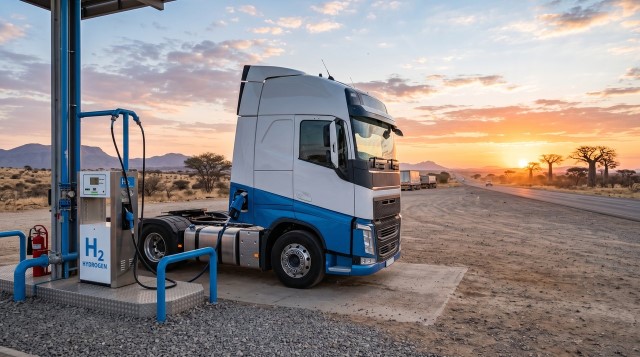
Daimler Truck AG, Volvo Group and Toyota Motor Corporation announced on 4 April 2026 that they will deepen their collaboration through cellcentric — the joint venture building hydrogen fuel-cell systems for heavy vehicles — to scale long-haul hydrogen trucking into a commercial product before 2030. For SADC fleet operators, the alliance compresses the decarbonisation timeline from speculative to actionable.
CARBON FOOTPRINT
8 May 2026 • 4 min read
Three of the world's largest truck OEMs are now committed to a single hydrogen fuel-cell stack programme for long-haul heavy duty applications. Combined with Volvo's hydrogen-combustion truck on-road testing announced on 1 April, the message to SADC fleet operators is direct: the second-hand hydrogen truck market is now on a calendar — and Walvis Bay's green hydrogen ambitions just acquired a delivery partner.
cellcentric was originally a Daimler-Volvo joint venture aimed at industrialising hydrogen fuel-cell stacks for heavy commercial vehicles. The April 2026 framework adds Toyota Motor Corporation as a deeper technical partner, broadening the cell technology pool, sharing development cost across three of the world's largest truck and automotive OEMs, and signalling intent to bring hydrogen fuel-cell long-haul to commercial production before the end of the decade.
The agreement remains non-binding, but the trio's intent is clear. Hydrogen fuel cells offer fast refuelling and high energy density, both of which suit long-haul trucking, mining haul fleets and other applications where battery-electric remains range-limited. Three days earlier, on 1 April 2026, Volvo Group separately confirmed it had begun on-road testing of heavy trucks powered by hydrogen-combustion engines as a parallel decarbonisation pathway — running alongside its battery-electric and HVO bridge-fuel programmes.
The alliance: Daimler Truck + Volvo Group + Toyota Motor Corporation deepening cellcentric collaboration on hydrogen fuel-cell systems for heavy-duty trucks and energy-intensive applications. (Source: Highways Today / Volvo Group press release, April 2026)
SADC fleet operators typically run European-OEM heavy trucks in the 5-7 year second-hand lag relative to the EU. That means hydrogen fuel-cell trucks reaching commercial production in Europe by 2028-2029 will start landing in SADC second-hand fleets from roughly 2033-2035 — but the depot, hydrogen-supply and route-network decisions that determine whether those trucks can be operated must be made well before the trucks themselves arrive.
Three SADC programmes are already shaping that infrastructure. Namibia's CMB.TECH-led hydrogen freight train trial on the Walvis Bay-Windhoek corridor, scheduled for 2026, is producing real green-hydrogen demand and supply data. The 2026 SADC Sustainable Energy Week at Victoria Falls placed transport electrification on the regional agenda. And South Africa's Carbon Tax Phase 2, GLEC framework adoption and JSE Scope 3 reporting push are pricing emissions into freight contracts in ways that did not exist in 2023.
European OEMs are intentionally running parallel battery-electric, hydrogen fuel-cell and hydrogen-combustion programmes, with HVO biofuel as a near-term bridge. SADC operators should mirror that structure rather than picking a single technology winner. Last-mile and short-haul distribution skews to battery-electric — already commercially mature in metro applications. Long-haul corridors with predictable refuelling stops favour hydrogen fuel cells. Retrofit-friendly fleets in transition can run HVO blended diesel through existing engines without engine swaps.
The decisions to make in 2026 are not whether to buy a hydrogen truck — none are sold in SADC yet — but rather: which depot has the electrical capacity for a future battery-electric tractor; which corridor (Walvis Bay-Lubumbashi, Durban-Harare, Beira-Lusaka) has the political and supply economics to carry early hydrogen pilots in the 2030s; and how to structure customer contracts so that the operator captures the carbon-intensity premium when the technology arrives.
Treat the cellcentric expansion as a planning trigger, not a procurement trigger. Add a hydrogen-readiness line to every depot real-estate decision in 2026 (electrical capacity, water access, refuelling footprint), pilot GLEC-aligned emissions reporting with one anchor customer this year, and lock in HVO or biodiesel blend supply contracts as the genuine 2026-2030 bridge. The operators who plan now will have routes when the technology actually lands.
Stay connected with Southern Africa's freight and transport community.
Join 6,400+ logistics professionals across the SADC region.
Visit Laaimylorrie.com| About the Author | |

|
Andre Klynsmith Entrepreneur & Technology Enthusiast Andre's expertise spans technology, blockchain, transport, and logistics — with a passion for innovation and driving positive change across industries. |
| Source: Highways Today — Truck Giants Unite for Hydrogen Power View source › | 4 April 2026 |


Subscribe to our Newsletter and stay in the know with all the latest Industry News, Products and Trends covering the whole of the SADC region.
KS Blockchain T/A Laaimylorrie.com . All Rights Reserved.