Industry related headlines to keep you in the know.
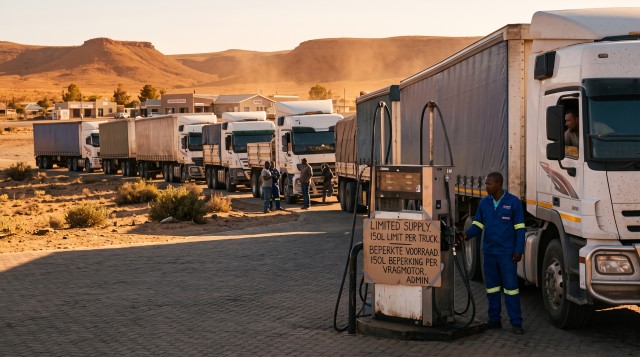
South Africa's first-quarter 2026 fuel scare -- in which national strategic reserves were reported to have fallen to roughly two weeks of cover, individual stations rationed customers to 40 to 100 litres each, and pumps in Kakamas and Upington ran dry -- has shifted from headline to lesson. Government and the Fuels Industry Association insist supply is stable, but the Q1 episode has changed how SADC supply chain managers think about fuel as a single point of failure.
Supply Chain Management
7 May 2026 • 4 min read
South Africa's two-week strategic fuel reserve was the headline; the operational reality on the ground -- station-level rationing, dry pumps in the Northern Cape, panic-buying behaviour ahead of the April 1 price adjustment -- was the wake-up call. SADC supply chains that depend on SA-routed diesel learned in March that a 14-day buffer is too thin.
In the third week of March 2026, EWN reported that SA's strategic fuel reserves had fallen to approximately 14 days of national consumption cover, with the figure described as leaving the country "highly exposed" to import-leg disruption. The Department of Mineral and Petroleum Resources and the SA Petroleum Retailers Association issued near-daily reassurance statements that there was no shortage and that imports through mid-year were secured. On the forecourt, the picture was more uneven: stations in Kakamas and Upington ran dry, several Free State and Northern Cape outlets capped sales at 40 to 100 litres per customer, and Daily Maverick reported sustained "supply woes" through end-March.
The proximate cause was a collision of three factors: tight refined-product supply ahead of the 1 April price adjustment, accelerated panic-buying once the 14-day reserve number leaked publicly, and concurrent pressure on the slate account that limited importers' ability to absorb spot-market spikes.
The Q1 2026 readings: ~14 days strategic reserve cover, sales caps of 40-100 litres in selected outlets, dry-pump events in Northern Cape towns, government messaging dominated by panic-buying mitigation rather than capacity expansion. (Source: EWN / Moneyweb / Daily Maverick, March 2026)
SADC supply chain managers should be clear-eyed about what a 14-day SA reserve means for their own operations. The 14 days is national consumption cover -- it is not 14 days of inland-SADC supply. By the time refined product moves from Durban or Cape Town through SA wholesale, into Mozambican, Botswanan, Lesotho, Eswatini and Namibian pump networks, the practical buffer reaching cross-border haulier customers is shorter. A two-week SA reserve typically translates into about seven to ten days of effective buffer for a Lusaka-bound or Lilongwe-bound truck stop dependent on SA-routed product.
The corollary is that SADC operators learned in Q1 to triangulate. Operators with bulk-fuel agreements at Walvis Bay, Beira and Maputo emerged from the scare with no operational disruption. Those running single-source SA-only supply faced detoured trips, longer queues, and -- in the worst cases -- 24-48 hour productive truck downtime.
Three planning shifts now make sense for any SADC supply chain function that touches SA-sourced fuel. First, dual-source fuel supply at the truck-stop and depot level -- Walvis Bay, Beira and Maputo wholesale relationships are insurance, not redundancy. Second, build station-level fuel-availability monitoring into your fleet telematics -- the Q1 episode was characterised by uneven dry-pump distribution, and operators who knew which stations were full kept rolling. Third, model a 30-day operational fuel reserve at company level for high-utilisation fleets, even where it ties up working capital.
The Walvis Bay Dangote-Afreximbank fuel hub, when commissioned, will materially ease the Western SADC supply picture. Until then, Q1 2026 should be treated as a reference event -- not a one-off, but a base case for what happens when reserves thin and a price adjustment lands at the same time.
Treat fuel as a primary supply chain risk, not a procurement line item. Open a second wholesale supply relationship outside SA, plug live station-availability data into your telematics, and stress-test your fleet's productive uptime against a 7-day inland fuel disruption scenario. Companies that did this in February 2026 did not lose deliveries in March.
Stay connected with Southern Africa's freight and transport community.
Join 6,400+ logistics professionals across the SADC region.
Visit Laaimylorrie.com| About the Author | |

|
Andre Klynsmith Entrepreneur & Technology Enthusiast Andre's expertise spans technology, blockchain, transport, and logistics -- with a passion for innovation and driving positive change across industries. |
| Source: EWN -- SA highly exposed with just two weeks of fuel reserves / Moneyweb -- Fuel rationing sets in View source › | March 2026 |


Subscribe to our Newsletter and stay in the know with all the latest Industry News, Products and Trends covering the whole of the SADC region.
KS Blockchain T/A Laaimylorrie.com . All Rights Reserved.