Industry related headlines to keep you in the know.
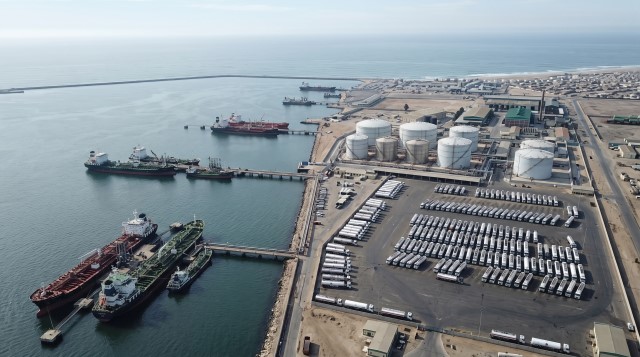
Namibia is being positioned as Southern Africa's next budget fuel hub through a roughly $10 billion plan that links the Dangote Refinery in Lagos to a tank-farm complex at Walvis Bay, a 2,000-kilometre fuel pipeline through Botswana to Bulawayo, and an Afreximbank-backed fleet of about 550 fuel tankers. If executed at the timetable announced, regional fuel costs could fall 15 to 20 percent within 18 months -- a structural change in SADC freight economics.
Distribution
7 May 2026 • 4 min read
The Walvis Bay fuel hub plan combines a Lagos-to-Walvis sea leg of under five days, 1.6 million barrels of bulk storage on the Atlantic coast, a 2,000km inland pipeline, and a 550-tanker secondary distribution fleet. For a region that has spent years routing refined product from Durban or Mombasa, it is the most consequential downstream petroleum proposal in a decade.
The plan, announced through linked Dangote and Afreximbank disclosures and confirmed by The Namibian and EWN in early May 2026, has four components. First, a tank farm at Walvis Bay capable of holding at least 1.6 million barrels of refined petrol and diesel. Second, a sea leg from Dangote's 650,000-barrel-per-day Lagos refinery to Walvis Bay completed in under five days -- a fraction of the 21-30 day round trip Southern Africa currently runs from Indian Ocean refineries. Third, a 2,000-kilometre fuel pipeline routed Walvis Bay -- Trans-Kalahari -- Botswana -- Bulawayo, which would land bulk product directly into the Zimbabwe and northern Botswana wholesale market. Fourth, an Afreximbank-backed initial fleet of about 550 secondary distribution tankers to move product from regional bulk depots to retail outlets and large fleet customers.
Pricing claims attached to the plan are aggressive. Public statements project a 15-20 percent reduction in delivered fuel cost in the SADC interior within 18 months of full commissioning, driven by shorter sea legs, fewer transit handovers, and the elimination of multiple intermediary mark-ups currently embedded in the Durban-Harare and Beira-Lusaka supply chains.
Hub plan in numbers: ~$10bn package, 1.6 million barrels storage, 2,000km pipeline (Walvis Bay → Botswana → Bulawayo), ~550 tanker secondary fleet, <5 day Lagos-to-Walvis sea leg, 15-20% delivered-cost reduction targeted within 18 months. (Source: The Namibian / Afreximbank-Dangote disclosures, May 2026)
Today, refined fuel into Zimbabwe, Zambia, Botswana and Malawi typically arrives via Durban, Beira or Dar es Salaam, then moves inland by rail and road. Each handoff adds storage fees, throughput tariffs, transit duty exposure, and a margin layer for the wholesaler holding the in-transit working capital. The Walvis Bay hub compresses that chain.
For SADC distribution operators, three implications matter. First, last-mile tanker work will accelerate in Botswana, Zimbabwe and northern Namibia as the hub commissions. Second, fuel retailers and large industrial off-takers will need to renegotiate supply contracts to capture the lower delivered-cost. Third, freight forwarders should expect Walvis Bay's container and break-bulk volumes to grow as the port hardens its position as a multi-product gateway.
Three risks should temper the headline excitement. Pipeline construction at 2,000km through Botswana to Bulawayo is a multi-year programme with right-of-way and water-crossing engineering challenges. Dangote refinery throughput has been variable since commissioning and any sustained dip would tighten Walvis Bay supply. And the regulatory layer -- export licensing, transit-bond arrangements between Namibia, Botswana and Zimbabwe, and pump-price formula adjustments in each destination state -- will determine how quickly the cost reduction reaches the end customer.
Even with those caveats, the plan structurally tilts SADC's downstream petroleum geography westward for the first time in modern history. Distribution operators who pre-position assets and contracts in Walvis Bay, Trans-Kalahari and the Botswana-Zimbabwe corridor will be the first to benefit.
If you run tanker assets, get a Walvis Bay-side capability into your 2027 plan -- the secondary distribution fleet alone will absorb material capacity. If you buy fuel at scale, ask suppliers for an indicative Walvis Bay landed-cost quote so you can benchmark today's Durban-routed pricing. And if you forward freight through Namibia, expect Walvis Bay congestion to rise as the hub builds out -- pre-book port slots and bonded-warehouse space accordingly.
Stay connected with Southern Africa's freight and transport community.
Join 6,400+ logistics professionals across the SADC region.
Visit Laaimylorrie.com| About the Author | |

|
Andre Klynsmith Entrepreneur & Technology Enthusiast Andre's expertise spans technology, blockchain, transport, and logistics -- with a passion for innovation and driving positive change across industries. |
| Source: The Namibian -- Namibia poised as Southern Africa's new budget fuel hub View source › | May 2026 |


Subscribe to our Newsletter and stay in the know with all the latest Industry News, Products and Trends covering the whole of the SADC region.
KS Blockchain T/A Laaimylorrie.com . All Rights Reserved.