Industry related headlines to keep you in the know.
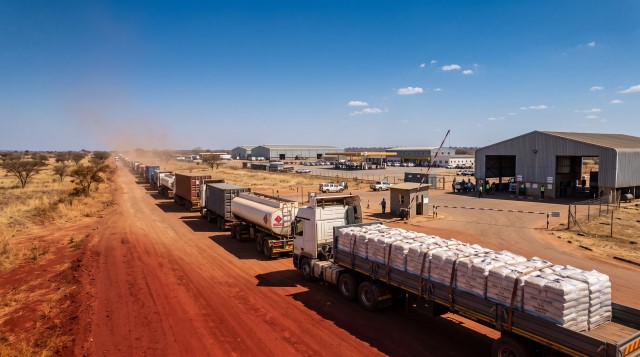
The Democratic Republic of the Congo's 2026 cobalt quota framework permits 96,600 tonnes of exports for the year, but Q1 2026 customs clearance data suggests less than half of allocated volumes are physically leaving DRC mine gates -- with the shortfall now blamed on collapsed bridges, paperwork friction and the limits of SADC corridor capacity.
Mining and Commodities
5 May 2026 • 4 min read
After replacing its February-October 2025 export ban with a quota system, the DRC's policy intent was a managed re-entry into the cobalt market. The Q1 2026 reality is different: between December 2025 and February 2026, only about 7,800 tonnes received export clearance against allocations significantly larger than that. The mismatch is now a SADC freight story, not a Kinshasa policy story.
The DRC government's policy timeline is straightforward: a complete export ban from February to October 2025; replacement with a quota-and-licence regime in late 2025; and a 2026 annual quota of 96,600 tonnes -- 87,000 tonnes distributed pro-rata to producers and 9,600 tonnes retained under Arecoms discretionary control. The market read coming into 2026 was that quota-cleared cargo would flow out of Lubumbashi and Kolwezi in roughly even monthly tranches.
Industry data tells a different story. Logistics operators on the Lubumbashi-Durban, Kolwezi-Walvis Bay and Kolwezi-Lobito routes report Q4 2025 / Q1 2026 actual export volumes running at roughly one-third to one-half of allocated quota. Cobalt hydroxide is reportedly accumulating at producer warehouses and at Kasumbalesa and Mokambo border posts faster than corridor capacity can move it.
Industry figure: Between December 2025 and February 2026, approximately 7,800 tonnes of cobalt hydroxide received DRC export clearance -- roughly 2,600 tonnes per month, well below the theoretical capacity implied by the 2026 quota allocation. (Source: Fastmarkets / S&P Global, 2026)
The first chokepoint is physical infrastructure. A bridge collapse on a major Lubumbashi-Kasumbalesa feeder route in late 2025 forced extended detours and added two-to-four days of round-trip time on the SA gateway corridor. The second is documentary friction -- Arecoms quota allocation letters do not always align cleanly with OCC, DGDA and customs systems, generating delays at the border. The third is the limited number of certified hazardous-cargo operators able to handle cobalt hydroxide consignments, which compresses available trucking capacity into a small specialist pool.
All three constraints favour operators who already run multi-route capability into the Copperbelt. Walvis Bay-Kolwezi has gained relative attractiveness as the Beitbridge / Kasumbalesa east-coast route has slowed. The Lobito Atlantic Railway, which began limited freight services in 2024, continues to grow its share of cobalt-flow volumes for west-bound shipments to Europe and North America.
If clearance rates remain near 2,600 tonnes per month, full-year 2026 actual exports could land somewhere between 30,000 and 45,000 tonnes -- well under the 96,600-tonne quota and roughly half of pre-ban 2024 volumes. That gap supports cobalt prices in the short term but also generates a building inventory backlog at producer sites that will eventually have to clear, with material risk of corridor saturation later in 2026.
Producers with fixed offtake contracts to European battery makers or Asian cathode plants are now actively renegotiating delivery windows. SADC freight operators with hazardous-cargo permits and multi-corridor presence are best placed to absorb that demand reshuffle.
Hazardous-cargo and Copperbelt-experienced operators should expect surging spot enquiries through Q2-Q3 2026 as producers race to clear backlog ahead of fixed-contract penalties. Pre-positioning bonded warehousing capacity at Kasumbalesa, Lubumbashi and Walvis Bay is the most immediate competitive lever; multi-route flexibility is the medium-term hedge.
Stay connected with Southern Africa's freight and transport community.
Join 6,400+ logistics professionals across the SADC region.
Visit Laaimylorrie.com| About the Author | |

|
Andre Klynsmith Entrepreneur & Technology Enthusiast Andre's expertise spans technology, blockchain, transport, and logistics -- with a passion for innovation and driving positive change across industries. |
| Source: Fastmarkets / S&P Global Commodity Insights View source › | 5 May 2026 |


Subscribe to our Newsletter and stay in the know with all the latest Industry News, Products and Trends covering the whole of the SADC region.
KS Blockchain T/A Laaimylorrie.com . All Rights Reserved.