Industry related headlines to keep you in the know.
Anti-migrant movement Operation Dudula is leading a countrywide shutdown across South Africa on 4 May 2026, with calls for businesses, schools and workplaces to close as the campaign against foreign nationals — including foreign-employed truck drivers — gains national reach.
TRANSPORTATION
4 May 2026 • 5 min read
The 4 May shutdown is the latest escalation of the All Truck Drivers Foundation and Operation Dudula campaign demanding the removal of foreign truck drivers from South Africa's road freight industry. With the N3 already disrupted by truck blockades on 10 April, fleet operators must now plan around a national protest day that risks paralysing both metro and corridor freight movements.
Operation Dudula and aligned groupings have called for a complete national stay-away on Monday, 4 May 2026, demanding government remove all foreign national truck drivers from the road freight industry "with immediate effect." The shutdown follows months of escalating xenophobic marches that have prompted United Nations warnings, and comes weeks after multiple trucks blocked the N3 near Harrismith on 10 April 2026 in a similar protest action.
For SADC freight operators the threat is not symbolic. The Operation Dudula campaign has named the trucking sector specifically, and the All Truck Drivers Foundation (ATDF) has called for foreign drivers to be barred from operating within South Africa. The groups have organised in KwaZulu-Natal, Gauteng and the Free State — the same provinces that host the N3, N1 and N4 freight arteries that move cargo into Zimbabwe, Zambia, the DRC, Mozambique and Botswana.
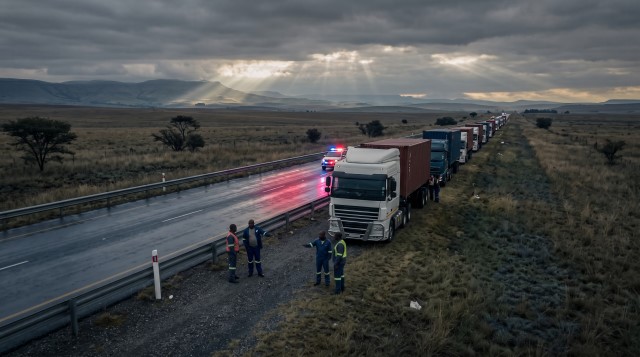
N3 disruption baseline: The 10 April 2026 truck blockade near Harrismith forced a full road closure in both directions and triggered hours of corridor congestion before SAPS reopened all lanes — a preview of what a coordinated shutdown could produce on a single day. (Source: African Insider, 2026)
The road freight industry has long employed cross-border drivers from Zimbabwe, Mozambique and Lesotho, particularly on long-haul routes where local recruitment has been strained by South Africa's well-documented driver shortage. Industry estimates put the country's structural shortfall at around 15,000 long-haul drivers — a gap that has historically been filled by experienced regional operators with valid work permits.
A separate high court order has banned the Operation Dudula leadership from demanding passports or IDs from private individuals or assaulting people identified as foreign nationals, but enforcement on a shutdown day will fall to SAPS units stretched across multiple metros. Operators with mixed-nationality driver pools will need to make hard calls about which fleets move and which stand down.
Beyond the immediate stay-away, the shutdown signals a structural risk that fleet managers must now price in: politically motivated road blockades targeting specific drivers and trucks. Insurance underwriters are already asking how operators screen routes for protest risk, and shippers running just-in-time inbound to Gauteng manufacturing plants are pushing forwarders for contingency commitments. The Beitbridge corridor — which clears more than 1,000 trucks per day after its 2025 modernisation — could see its newly compressed clearance times unravel if upstream protest disruption stacks vehicles into the holding yards.
For Namibian, Botswana, Zambian and Zimbabwean exporters routing through South Africa, the lesson is consistent with the 2024–2026 corridor diversification thesis: a single point of political fragility in the regional logistics network can absorb days of margin in hours. Operators that have already dual-routed through Walvis Bay, Maputo or Beira have more options than those that haven't.
Build a 4 May contingency plan now: pause non-critical metro and N3/N4 movements where possible, reroute time-sensitive cargo through alternative corridors, and brief drivers on de-escalation protocols and direct SAPS contact lines. Beyond this week, treat domestic political risk as a recurring planning input — corridor diversification and dual-sourced labour pools are no longer optional resilience tools.
Stay connected with Southern Africa's freight and transport community.
Join 6,400+ logistics professionals across the SADC region.
Visit Laaimylorrie.com| About the Author | |

|
Andre Klynsmith Entrepreneur & Technology Enthusiast Andre's expertise spans technology, blockchain, transport, and logistics -- with a passion for innovation and driving positive change across industries. |
| Source: Moneyweb / Daily Maverick / African Insider View source › | 4 May 2026 |


Subscribe to our Newsletter and stay in the know with all the latest Industry News, Products and Trends covering the whole of the SADC region.
KS Blockchain T/A Laaimylorrie.com . All Rights Reserved.