Industry related headlines to keep you in the know.
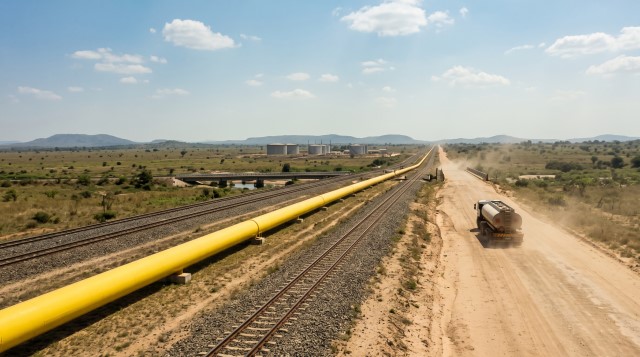
Companhia do Pipeline Moçambique-Zimbabwe (CPMZ) has confirmed plans to lift the throughput of its Beira-corridor fuel pipeline from 3 million cubic metres a year to 5 million cubic metres a year by 2027 — an upgrade that, when complete, will displace thousands of tanker-truck movements between the Port of Beira and Harare and reshape regional fuel supply economics for Zimbabwe, Zambia, Malawi, the DRC and Botswana.
SUPPLY CHAIN MANAGEMENT
3 May 2026 • 5 min read
Doubling pipeline capacity in less than three years would turn the Beira corridor into the cheapest, most resilient gateway for refined fuel into central SADC — at exactly the moment Strait of Hormuz disruptions and Section 122 tariffs are forcing every fuel buyer in the region to think harder about supply diversification.
CPMZ's pipeline runs roughly 287 kilometres from the Port of Beira to Maforga in Manica province and on to Feruka in Zimbabwe. It was designed in an era when Zimbabwean fuel demand was a fraction of today's, and when the pipeline's primary role was simply to keep Harare supplied. Three decades on, it is the principal fuel artery for not just Zimbabwe but increasingly for hinterland markets in the DRC, Zambia, Malawi and Botswana, with last-mile distribution typically handled by road tankers from Harare-area depots.
An earlier upgrade lifted capacity from 2 to 3 million cubic metres a year, with new platforms inaugurated at the Port of Beira and at Maforga in August 2024. The next step — to 5 million cubic metres by 2027 — will require a combination of additional pumping capacity, line de-bottlenecking and storage upgrades at both the Beira and Feruka ends, and is being planned alongside the broader Beira corridor financing package the Mozambican government has been pursuing with Chinese and DFI partners since early 2026.
Capacity step-change: CPMZ pipeline capacity rose from 2 to 3 million m³/year in August 2024 and is targeting 5 million m³/year by 2027 — a 67% lift in under three years. (Source: Club of Mozambique / Megaproject, 2024–2026)
The simplest way to understand the impact is in tanker-truck equivalents. A standard fuel B-double tanker carries roughly 50,000 litres. Two million additional cubic metres of pipeline throughput is the equivalent of 40,000 long-haul tanker movements per year — or more than 100 fuel tanker trips a day removed from the Beira–Harare road, plus the further onward truck movements those same loads would have generated into Zambia, the DRC and Malawi.
For SADC freight operators, that has two structural consequences. First, road-tanker capacity currently locked into the Beira–Harare lane will be freed up for other liquid bulk and general freight work — at a time when cross-border driver shortages and Section 122-driven trade reshuffles are tightening the supply of qualified haulage. Second, the unit economics of fuel landed in Harare via pipeline are materially better than via road tanker, particularly given current diesel pricing in the region — which strengthens Beira's position as the cheapest landed-cost fuel route into central SADC.
The pipeline upgrade does not sit in isolation. The Mozambican government's April 2026 MoU with Chinese partners on the Beira Port Access Road and Dondo Logistics Terminal, the discussions around 24-hour operations at the Forbes-Machipanda border, and Cornelder de Moçambique's reported 58% year-on-year container throughput surge through 2025 all point in the same direction: Beira is in the middle of a multi-year reposition as a credible, scalable Indian Ocean gateway for inland SADC, complementing rather than competing with Walvis Bay's Atlantic-facing pivot.
For supply chain managers in fuel, mining, FMCG and humanitarian logistics, the practical question is no longer whether to consider Beira as a primary or backup route — it is how to structure contracts, inventory positioning and last-mile distribution to take advantage of the corridor's improving capacity and reliability before competitors do. The 2025–2027 window is when the corridor's pricing and slot allocation conventions will be set.
Fuel buyers and supply chain managers should formally re-baseline their landed-cost models for fuel into Zimbabwe, the DRC, Zambia and Malawi against a Beira-pipeline scenario for 2026 and a 5-million-cubic-metre Beira-pipeline scenario for 2027. Road tanker operators currently dependent on the Beira–Harare fuel lane should begin redeploying capacity into general liquid-bulk and cross-border container work over the next 18 months to avoid being left with stranded fleet.
Stay connected with Southern Africa's freight and transport community.
Join 6,400+ logistics professionals across the SADC region.
Visit Laaimylorrie.com| About the Author | |

|
Andre Klynsmith Entrepreneur & Technology Enthusiast Andre's expertise spans technology, blockchain, transport, and logistics — with a passion for innovation and driving positive change across industries. |
| Source: Club of Mozambique / Energy Capital & Power View source › | April 2026 |


Subscribe to our Newsletter and stay in the know with all the latest Industry News, Products and Trends covering the whole of the SADC region.
KS Blockchain T/A Laaimylorrie.com . All Rights Reserved.