Industry related headlines to keep you in the know.
President Donald Trump signed legislation in February 2026 reauthorising the African Growth and Opportunity Act (AGOA) through 31 December 2026 with retroactive effect to 30 September 2025 — but the political and tariff landscape AGOA exports now operate in is materially different from the one that existed when the programme last enjoyed bipartisan certainty.
POLITICS INSIGHT
3 May 2026 • 5 min read
AGOA is back on the books for the rest of 2026, but the Section 122 10% baseline tariff and the 25% auto-sector tariffs sitting on top of it have rewritten the export economics for SADC suppliers — particularly in South Africa. The eight months between now and 31 December are the planning window every exporter needs to use carefully.
The provision included in H.R. 7148, signed into law on 3 February 2026, restored AGOA's duty-free access for eligible sub-Saharan African exports until 31 December 2026, with retroactive effect to 30 September 2025 to cover the lapse period. That technically gives exporters in South Africa, Botswana, Lesotho, Eswatini, Mozambique, Namibia, Tanzania, Malawi, Zambia and other SADC AGOA beneficiaries continued preferential access to the US market for the rest of 2026.
The complication is that the renewal sits inside a US tariff regime that has been re-engineered around it. After the US Supreme Court's February 2026 ruling rescinded the IEEPA-based "reciprocal" tariffs imposed in April 2025, the administration responded by invoking Section 122 of the 1974 Trade Act to apply a 10% across-the-board tariff increase on imports from all countries — a measure that, by design, AGOA preference cannot fully neutralise.
Tariff position: South Africa now faces a 10% Section 122 baseline (down from 30% under the rescinded reciprocal regime) plus 25% auto-sector tariffs on vehicles and parts not exempt under Section 232. (Source: ISS Africa / Brownstein, March–April 2026)
SADC exporters do not face this regime the same way. South Africa is structurally exposed because its largest AGOA categories include autos and auto parts — which now carry the 25% sectoral tariff — and citrus, wine and ferro-alloys, all of which now sit on top of the 10% Section 122 baseline. Lesotho's textile sector, Eswatini's apparel exports and Madagascar's vanilla and apparel are similarly squeezed, with the AGOA preference materially eroded by the new baseline.
There is also a country-eligibility risk that should not be overlooked. The US' annual decision on AGOA eligibility — usually published in December — is widely expected to be more politically charged in 2026 than in any year since the programme's inception. South Africa, in particular, faces the possibility of being excluded from the December 2026 list, which would compound the tariff erosion with an outright loss of preference.
Exporters and their freight forwarders now have roughly eight months — May through December 2026 — to use AGOA's reauthorised window deliberately. That means three things in practice: front-loading shipments where customer demand and inventory cycles allow, locking in long-term off-take contracts that price in a post-AGOA scenario from January 2027, and accelerating market diversification toward AfCFTA, EU and Asian buyers. Freight forwarders should be having explicit conversations with US-bound customers about January 2027 contingency planning, including container-line capacity and routing implications.
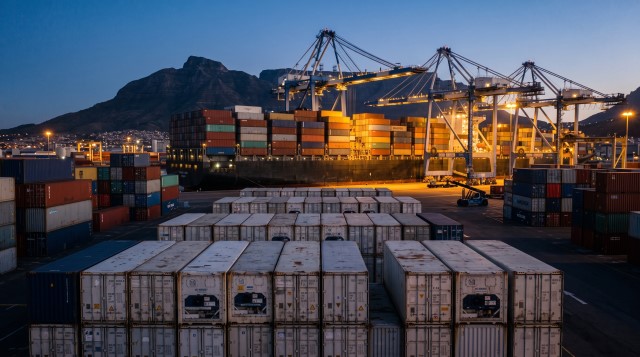
For SADC freight operators, the volume implications are significant. AGOA-driven exports support a measurable share of vessel-call patterns out of Durban, Cape Town and Coega, and feeder-service economics from Walvis Bay and Maputo. Any volume disruption in early 2027 will reshape carrier rotations and feeder allocations across the region. The carriers and forwarders that prepare scenarios now will be the ones still able to deliver service when the political ground shifts again.
Treat the May–December 2026 period as a finite planning window: front-load AGOA-eligible shipments where commercial terms allow, run two scenarios for January 2027 (AGOA renewed at parity vs. AGOA lapsed and South Africa de-listed), and start mapping AfCFTA, EU and Asian buyer alternatives now. Freight forwarders should be having explicit January 2027 contingency conversations with every US-bound customer this quarter.
Stay connected with Southern Africa's freight and transport community.
Join 6,400+ logistics professionals across the SADC region.
Visit Laaimylorrie.com| About the Author | |

|
Andre Klynsmith Entrepreneur & Technology Enthusiast Andre's expertise spans technology, blockchain, transport, and logistics — with a passion for innovation and driving positive change across industries. |
| Source: ISS Africa / USTR / Brownstein View source › | April 2026 |


Subscribe to our Newsletter and stay in the know with all the latest Industry News, Products and Trends covering the whole of the SADC region.
KS Blockchain T/A Laaimylorrie.com . All Rights Reserved.