Industry related headlines to keep you in the know.
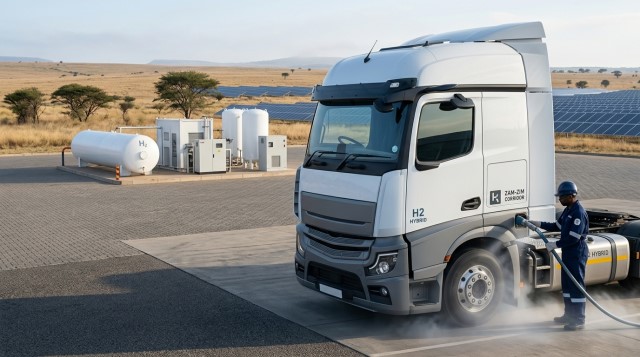
Daimler Truck has confirmed that its liquid-hydrogen fuel-cell truck — the GenH2 platform — will move into small-series production at the end of 2026, with around 100 trucks earmarked for early customer operations in Europe. The headline number is small, but the timing matters for SADC fleet operators trying to decide where hydrogen sits in their long-haul decarbonisation roadmap.
CARBON FOOTPRINT
2 May 2026 • 5 min read
Hydrogen-fuelled long-haul trucking has spent half a decade in the prototype lane. Daimler's late-2026 move into small-series production turns the technology into something European customers can actually order — and that is the signal SADC fleet operators have been waiting for to put a credible hydrogen line item into their post-2030 capex plans.
The Daimler Truck programme covers the GenH2 long-haul tractor unit running on liquid hydrogen rather than gaseous storage — a deliberate choice that gives the truck a longer operating range and a more energy-dense fuel envelope per kilogram of stored hydrogen. Daimler has put the small-series start at the end of 2026, with approximately 100 trucks scheduled for customer operations primarily on European long-haul corridors.
This is not a mass-market launch. Small-series production is the bridge between prototype validation and full industrial scale, and the 100-truck cohort is designed to test real-world duty cycles, fuel logistics, refuelling network density and total cost of ownership at customer-operating scale. Volvo's parallel hydrogen and battery-electric programmes — and the Volvo electric truck push for SADC routes already announced through 2026 — are part of the same European OEM transition that will set the residual-value benchmarks for the next ten years.
Industry milestone: ~100 liquid-hydrogen long-haul trucks moving into small-series customer operations from end-2026 — the first time hydrogen long-haul has crossed from prototype to series production at a mainstream OEM. (Source: Daimler Truck programme statements via Green Prophet, 2026)
SADC fleet decisions on long-haul tractor units have always been downstream of European OEM strategy. Whatever Daimler, Volvo, MAN, Scania and Iveco commit to in Europe sets the production volumes, the residual-value curves, the parts-network economics and the eventual second-hand fleet that arrives in Southern Africa five to seven years later. Hydrogen long-haul moving to small-series production now means that by the early 2030s, hydrogen-capable used Euro-spec trucks will start showing up on the Walvis Bay-Lubumbashi, Durban-Harare and Beira-Lusaka lanes if regional refuelling infrastructure is in place to support them.
That last condition is the binding one. Namibia is already trialling Africa's first hydrogen-fuelled freight train on the Walvis Bay-Windhoek corridor in 2026, the SADC Sustainable Energy Week in Victoria Falls this February locked in a regional commitment to transport electrification, and South Africa's first off-grid solar EV charging stations on the N3 corridor are now operational. The hydrogen layer of that infrastructure is only just emerging — and that is the gating factor on whether a 2032-2034 SADC hydrogen long-haul fleet looks plausible or fanciful.
The mistake to avoid is over-rotating to hydrogen on the basis of a 100-truck European cohort. The right posture for SADC operators is to read the small-series rollout as a signal that the long-haul decarbonisation path is now multi-pathway — battery electric for shorter duty cycles, hydrogen fuel-cell or hydrogen internal combustion for line-haul, and biofuel-blend or HVO diesel as the bridge for the existing fleet. Carbon Tax Phase 2 is already live in South Africa, the GLEC framework is becoming a contractual default for shippers, and the AfCFTA cold chain has emissions-reporting expectations baked in.
The practical 2026 and 2027 actions for fleet decision-makers are to fold a hydrogen-readiness assumption into corridor master-plans (depot real estate, electrical capacity, refuelling location options), to put a residual-value haircut on diesel tractors planned for purchase post-2028, and to set up emissions-reporting infrastructure that will support shipper RFPs from 2027 onwards. None of these require buying a hydrogen truck today. All of them set up the option to do so when the European used market reaches Southern Africa.
Daimler's small-series production decision is the single clearest signal yet that liquid-hydrogen long-haul is moving from "concept" to "fleet line item." SADC operators do not need to buy hydrogen trucks in 2026, but they do need to start building the infrastructure assumptions, residual-value models and emissions-reporting muscle that will make a 2030s hydrogen pathway commercially possible.
Stay connected with Southern Africa's freight and transport community.
Join 6,400+ logistics professionals across the SADC region.
Visit Laaimylorrie.com| About the Author | |

|
Andre Klynsmith Entrepreneur & Technology Enthusiast Andre's expertise spans technology, blockchain, transport, and logistics — with a passion for innovation and driving positive change across industries. |
| Source: Green Prophet — The future of trucking and freight is electric and hydrogen View source › | 2 May 2026 |


Subscribe to our Newsletter and stay in the know with all the latest Industry News, Products and Trends covering the whole of the SADC region.
KS Blockchain T/A Laaimylorrie.com . All Rights Reserved.