Industry related headlines to keep you in the know.
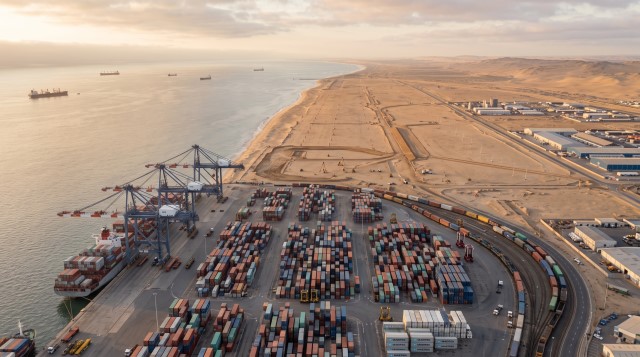
Namibia has formally moved its long-discussed North Port master plan into delivery mode, with Namport confirming that the 1,330-hectare Farm 39 site north of Walvis Bay will anchor a multi-decade port expansion estimated at around N$60 billion and designed to serve the Atlantic gateway demand created by Namibia's offshore oil and gas wave, the Trans-Kalahari and Trans-Cunene corridors, and the rerouting of SADC critical mineral exports.
Ports and Terminals
30 April 2026 • 5 min read
Walvis Bay is no longer just dredging deeper — it is preparing to build an entirely new port. The N$60 billion North Port programme on Farm 39 reframes Namibia's role from a feeder of South African ports to a stand-alone Atlantic gateway for SADC, with dedicated land set aside for energy, container, and dry-bulk clusters.
The North Port project sits one step beyond the upgrades already underway at the existing Walvis Bay container and oil terminals. Where the current channel deepening to 17 metres and the Terminal Investment Namibia (TIN) container terminal concession were designed to handle today's volumes more efficiently, Farm 39 is sized for the next two decades of demand. Namport has earmarked roughly 1,330 hectares of coastal and inland land for berths, terminals, logistics zones, and back-of-port industrial activity.
The masterplan splits the site into purpose-built clusters — energy, containers, dry bulk, project cargo and bonded logistics — rather than the single multi-purpose layout of the existing port. That clustering matters for SADC freight operators because it allows oil and gas project cargo, copper containers from the DRC, and uranium drums from Namibia's Erongo region to be handled in parallel without competing for the same berths or yard space.
Project size: Namport has confirmed Farm 39 covers approximately 1,330 hectares, with a long-run capital programme estimated at around N$60 billion across phased terminals, berths, and back-of-port land. (Source: Namibian Ports Authority, 2026)
Three structural shifts have moved the Atlantic gateway question from theoretical to urgent. First, BP's April 2026 acquisition of a 60% operating stake in Namibia's offshore Walvis Basin, alongside earlier moves by TotalEnergies, Shell, Galp and bp's partner companies, is creating multi-year demand for project cargo, supply-base services and bonded warehousing on the Namibian coast. Second, congestion and reform delays at South Africa's east coast ports continue to push DRC, Zambian and northern Botswana cargo to look for alternatives. Third, the Trans-Kalahari and Lobito corridors are competing for the same Copperbelt and southern Angola volumes, and Walvis Bay needs the physical capacity to make a credible western SADC offer.
The N$4 billion Lüderitz expansion already announced in 2025/26 is a complementary play — Lüderitz takes the oil and gas supply base load while Walvis Bay scales for containers, energy export terminals and back-of-port logistics. That division of labour means Namibia's two ports can finally specialise instead of competing for the same project cargo.
Namport has signalled that the North Port will be delivered in phases over two decades, with early infrastructure works — land preparation, road access, dredging studies and utility corridors — likely to anchor the 2026/27 budget cycle. Detailed terminal concessions are expected to follow, with private operators bidding for the energy and container clusters once the masterplan is gazetted. The financing model is expected to mix Namport equity, SADC development finance, sovereign-backed instruments and private operator capital.
For freight operators, the window between announcement and operational capacity is exactly when relationship-building, land assembly along the corridor, and bonded warehouse positioning create lasting commercial advantage. Operators that wait until terminal commissioning to engage will find the back-of-port warehousing market already locked in by faster-moving competitors — the same pattern observed at Maputo, Beira and Durban over the past decade.
Namibia's Atlantic gateway story has moved from incremental upgrades to a stand-alone new-port programme — and that changes the cost case for routing DRC, Zambian and Botswana cargo through Walvis Bay. SADC operators should start mapping inland linkages, bonded depot opportunities and cross-corridor pricing scenarios now, not when the first new berth opens.
Stay connected with Southern Africa's freight and transport community.
Join 6,400+ logistics professionals across the SADC region.
Visit Laaimylorrie.com| About the Author | |

|
Andre Klynsmith Entrepreneur & Technology Enthusiast Andre's expertise spans technology, blockchain, transport, and logistics -- with a passion for innovation and driving positive change across industries. |
| Source: Namibian Ports Authority — North Port of Walvis Bay, SADC Gateway Development View source › | 30 April 2026 |


Subscribe to our Newsletter and stay in the know with all the latest Industry News, Products and Trends covering the whole of the SADC region.
KS Blockchain T/A Laaimylorrie.com . All Rights Reserved.