Industry related headlines to keep you in the know.
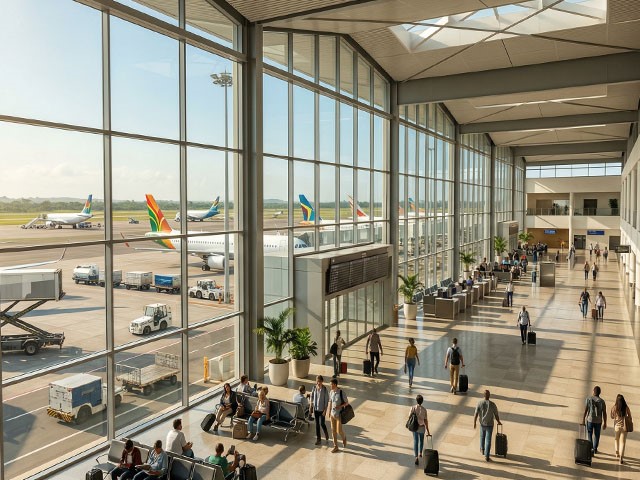
Angola's Dr. António Agostinho Neto International Airport in Luanda completed its full operational transition in March 2026, with all airline services now relocated to Africa's newest major aviation hub — a facility designed for 15 million passengers and 130,000 tonnes of cargo annually, with phased expansion capacity far beyond those initial figures.
Aviation
26 March 2026 • 4 min read
The full migration of airline operations to Luanda's new airport marks the end of decades of constrained air freight capacity in Angola. With 130,000 tonnes of annual cargo capacity, a rail link to the city being restored in 2026, and a consortium led by Corporacion America Airports at the helm, the new airport is positioned as a significant air cargo hub for Central and Western Africa — and its implications for SADC freight operators are real.
The previous Quatro de Fevereiro Airport had long been recognised as a bottleneck in Angola's logistics ecosystem — inadequate runway capacity, aging cargo infrastructure, and persistent congestion limited both passenger growth and freight throughput. The new Dr. António Agostinho Neto International Airport, located in Ícolo e Bengo province approximately 40 kilometres from central Luanda, resolves these constraints in one step. Phase one delivers a single terminal rated at 15 million annual passengers, and a dedicated cargo terminal with 130,000 metric tonnes of annual throughput capacity.
By 5 January 2026, average daily departures had already risen to 19 — a significant improvement from the congested patterns at the old facility. Airlink, one of Southern Africa's most active regional carriers, completed its migration to the new airport on 1 March 2026, with TAAG Angola Airlines having transferred international operations earlier. The full transition is now complete, giving the cargo industry the operational certainty it needs to commit capacity.
Cargo capacity: The Dr. António Agostinho Neto International Airport's cargo terminal is designed to handle 130,000 metric tonnes annually in its initial phase, with expansion provision built into the master plan. (Source: Aviation Week Network, 2025)
A key differentiator for the new airport — and one that specifically benefits freight operators — is the planned restoration of the Luanda Railway Company rail service directly to the airport. Service was temporarily suspended in mid-2025 for safety works; resumption is targeted for early 2026. Rail connectivity between Luanda's port area, the city centre and the airport will create a genuine multimodal freight option: sea-to-air and road-to-air transfers become more practical when truck dwell times at congested urban access roads are bypassed via rail.
This matters for perishables, pharmaceuticals, high-value electronics and other cargo categories where speed and temperature integrity are non-negotiable. Angola is actively expanding its agricultural and fisheries export base, and air freight provides the only viable channel for time-sensitive products to reach European, Middle Eastern and Asian markets within acceptable shelf-life windows.
The IATA-identified statistic that 19% of African city pairs remain unserved by direct air services underscores the connectivity gap that new hub capacity helps address. Luanda, positioned on the Atlantic seaboard and geographically central to both West and Central Africa, can now serve as a genuine transit hub for cargo moving between SADC and South American, European and Middle Eastern markets. TAAG Angola Airlines has been building its network, and the improved infrastructure should attract additional scheduled freighter services that were previously deterred by inadequate ground handling facilities.
For SADC freight forwarders currently routing air cargo through Johannesburg OR Tambo or Nairobi's JKIA, the fully operational Luanda airport presents a new routing option worth evaluating — particularly for cargo originating from or destined to Angola, DRC and Zambia. As Angola and DRC integrate more deeply into the SADC Free Trade Area, air freight flows between these markets and the rest of the region are likely to grow materially over the next three to five years.
Luanda's new airport opens a credible air freight corridor for time-sensitive SADC cargo that previously had no viable Angolan routing option. Freight forwarders handling pharmaceutical, perishable and high-value cargo between southern and central Africa should assess whether direct Luanda routing reduces transit time and cost compared to connecting through Johannesburg — because by the time the rail link is fully restored, the economics will shift.
Stay connected with Southern Africa's freight and transport community.
Join 6,400+ logistics professionals across the SADC region.
Visit Laaimylorrie.com| About the Author | |

|
Andre Klynsmith Entrepreneur & Technology Enthusiast Andre's expertise spans technology, blockchain, transport, and logistics — with a passion for innovation and driving positive change across industries. |
| Source: Aviation Week Network / African Pilot / FurtherAfrica View source › | 26 March 2026 |


Subscribe to our Newsletter and stay in the know with all the latest Industry News, Products and Trends covering the whole of the SADC region.
KS Blockchain T/A Laaimylorrie.com . All Rights Reserved.