Industry related headlines to keep you in the know.
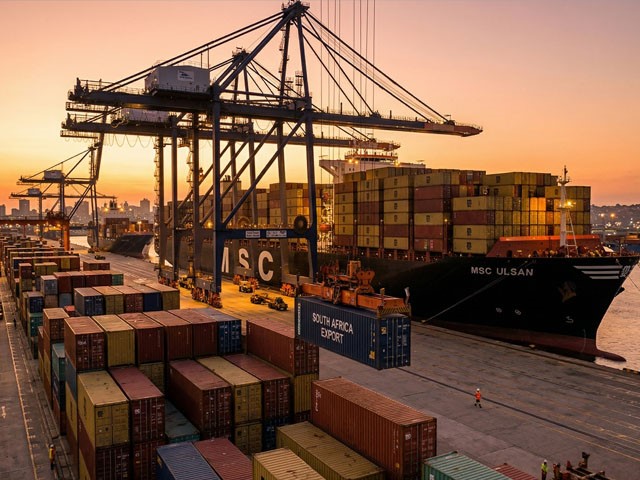
South Africa and its SADC neighbours are scrambling to redirect export cargo flows after the United States confirmed a 30% reciprocal tariff on South African goods — a seismic shift that is already reshaping which ports, corridors, and carriers Southern African freight operators will rely on through the rest of 2026.
Economy and Markets
25 March 2026 • 3 min read
America's sweeping tariff regime — 30% on South Africa, 50% on Lesotho, 47% on Madagascar — is forcing a rapid rethink of SADC's export logistics map. For freight operators across the region, the question is no longer whether trade routes will change, but how fast they can adapt.
The US reciprocal tariff regime, which took effect following the April 2025 "Liberation Day" executive order and is being phased in through 2026, imposes a minimum 10% baseline on all US imports — rising sharply for SADC countries. South Africa faces 30%, Lesotho 50%, Madagascar 47%, Mauritius 40%, and Mozambique 16%. South Africa's automotive exports to the US, already one of its most significant trade flows, have collapsed: vehicle exports dropped from 25,544 units to just 6,530 in the year following the tariff announcement — a 75% decline.
Citrus, wine, grapes, processed foods, and macadamia nuts are also directly in the crosshairs. Citrus alone generates approximately R1.8 billion annually from the US market, and analysts warn that up to 35,000 jobs in the sector could be lost if alternative markets are not secured quickly. The broader agricultural and automotive exposure puts as many as 100,000 jobs across Southern Africa at risk.
Tariff exposure: South Africa's exports to the US face a 30% reciprocal tariff — the highest applied to any significant SADC trading partner. SA auto exports to the US have already fallen 75% in the 12 months since the tariff was announced. (Source: The DTIC / tralac, 2026)
SADC exporters are not sitting still. The EU remains the region's largest alternative market and is being actively targeted for expanded citrus, wine, and automotive trade. China and Gulf state importers are absorbing growing volumes of South African bulk commodities, chrome, and agricultural produce. Intra-African trade — supercharged by the AfCFTA tariff phase-down programme — is also emerging as a genuine alternative, with SADC-to-SADC cargo flows increasing on key corridors as cross-border barriers fall.
For freight operators, this pivot translates into higher volumes on the SADC North-South Corridor (Durban to Lusaka and Dar es Salaam), increased eastbound container flows through the Port of Durban and Walvis Bay toward Asian markets, and growing demand for flexible multi-modal solutions that can absorb rapidly changing cargo mix. Carriers are also reweighting service loops, with several MSC and Maersk Asia-Southern Africa strings already adjusted in 2026 to reflect the new demand geography.
The rand has come under sustained pressure, having traded around R19 to the US dollar through early 2026, with tariff uncertainty compounding load-shedding and political risks. For importers, a weaker rand directly raises the landed cost of any goods priced in US dollars — from machinery to industrial inputs — squeezing margins and forcing procurement teams to reopen supplier contracts. Fuel cost exposure is also elevated since South African diesel prices are dollar-linked through the benchmark import parity pricing formula.
Freight rates on SADC trade lanes have so far remained relatively stable, supported by the structural over-supply of capacity on Asia-Africa lanes first identified in late 2025. But this buffer may erode as volumes shift and carriers rationalise frequency on routes where US-bound export backhaul cargo has dried up. Operators who lock in annual freight contracts now, before the full effect of trade diversion plays out, are likely to be better positioned than those waiting for the market to settle.
Freight operators should expect both disruption and opportunity: US-bound cargo lanes are contracting, but EU, Gulf, and intra-AfCFTA flows are growing fast. Operators who invest now in multi-corridor capability — particularly on North-South, Beira, and Walvis Bay routes — and who can offer flexible consolidation services for exporters pivoting away from the US will be best placed to capture the new trade flows reshaping SADC logistics in 2026.
Stay connected with Southern Africa's freight and transport community.
Join 6,400+ logistics professionals across the SADC region.
Visit Laaimylorrie.com| About the Author | |

|
Andre Klynsmith Entrepreneur & Technology Enthusiast Andre's expertise spans technology, blockchain, transport, and logistics -- with a passion for innovation and driving positive change across industries. |
| Source: tralac Trade Law Centre / The DTIC View source › | 25 March 2026 |


Subscribe to our Newsletter and stay in the know with all the latest Industry News, Products and Trends covering the whole of the SADC region.
KS Blockchain T/A Laaimylorrie.com . All Rights Reserved.