Industry related headlines to keep you in the know.
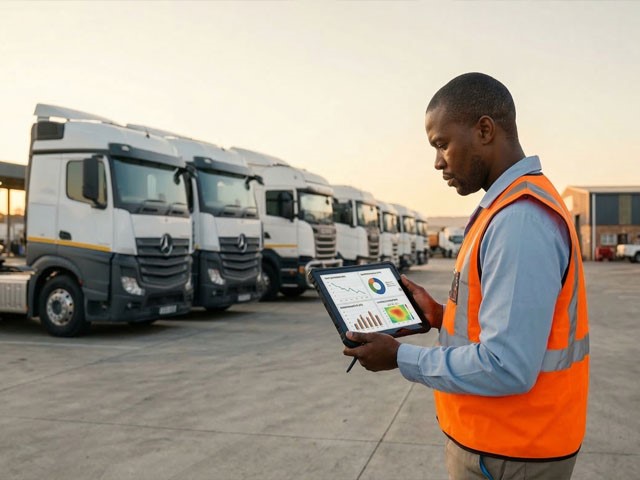
With fuel costs elevated, interest rates still above pre-pandemic levels, and the average fleet age across Southern Africa sitting at over a decade, understanding the true total cost of ownership (TCO) of a commercial vehicle has never been more important — yet most SADC fleet operators still manage assets based on purchase price alone, leaving significant cost-reduction potential untapped.
Asset Management
15 March 2026 • 5 min read
Africa's fleet management market is growing at 15–18% per year and is forecast to reach USD 4.2 billion by 2027 — driven largely by operators who have discovered that managing TCO systematically can dramatically improve margins. In 2026's high-cost environment, TCO mastery is the clearest competitive advantage available to SADC transport businesses.
Total cost of ownership is the complete cost of operating a vehicle over its working life, not just the sticker price. A proper TCO calculation covers acquisition cost minus projected residual value, financing costs over the ownership period, fuel consumption, preventive and corrective maintenance, tyres, licensing and compliance, insurance, driver costs, and downtime losses — the cost of revenue not earned while a vehicle is off the road. When you add all of these components together across a truck's lifespan, the acquisition cost typically represents only 15–25% of the total. The rest is operational.
This matters enormously for SADC operators in 2026. With diesel prices at historically elevated levels following the global fuel market disruptions of the past 18 months, and maintenance costs rising due to parts import price inflation, the operational cost components of TCO have grown substantially faster than acquisition costs. A fleet operator who bought trucks at a "good price" but has no visibility into fuel-per-kilometre, maintenance cost-per-kilometre, or downtime hours per month is effectively managing blind — and paying for it without realising it.
Market growth: The Middle East & Africa fleet management market is projected to reach USD 4.2 billion by 2027, growing at a CAGR of 15–18%, as operators shift from paper-based maintenance records to digital TCO monitoring platforms. (Source: Mobility Foresights, 2025)
Industry analysts consistently identify fuel theft and vehicle downtime as the two largest and most controllable TCO drains for African fleet operators. Fuel theft — through siphoning, fraudulent fills, or inflated trip reports — can silently consume 5–10% of a fleet's total fuel budget. Unplanned breakdowns on corridor routes, particularly in remote areas between Beitbridge and Chirundu, the Namibia-Zambia corridor, or the Mozambique coastal road, routinely cost operators not just the repair bill but one to three days of lost revenue, driver accommodation, and cargo penalties.
Predictive maintenance — integrating real-time OBD-II vehicle data, fuel sensors, and AI-based fault prediction — is the technology response to both problems. Operators who have deployed these systems report not only reduced unplanned downtime but also substantial fuel cost reductions as genuine consumption baselines are established and deviations flagged automatically. The initial investment in telematics and fleet management software is typically recovered within six to twelve months at current fuel prices.
One of the most valuable outputs of rigorous TCO tracking is clarity on the optimal vehicle replacement point. Across SADC, the default approach has been to run trucks until they are uneconomical to repair — a strategy that made sense when new truck prices were lower relative to income, but which is increasingly costly in an era of high interest rates, fuel surcharges, and strict cross-border compliance requirements for older vehicles. A truck whose maintenance cost-per-kilometre has started to exceed the industry average benchmark by more than 20% is almost certainly eroding margin on every load carried.
Fleet leasing has emerged as a practical alternative for SADC operators who want to stabilise TCO without large capital outlays. Several South African vehicle financiers now offer operating lease structures that include full-maintenance cover, tyres, and tracking — effectively converting an unpredictable TCO into a known, fixed cost-per-kilometre. For operators quoting freight rates in highly competitive corridors, this predictability is a direct competitive advantage when building margin into a tender.
In 2026's high-cost, high-competition environment, the transport businesses that will grow margins are those tracking TCO by vehicle, route, and driver — not just total fleet running costs. Start by establishing cost-per-kilometre baselines, deploy fuel monitoring on your highest-volume vehicles, and review maintenance cost trends quarterly. The data will identify your most and least profitable assets with a precision that gut feel never can.
Stay connected with Southern Africa's freight and transport community.
Join 6,400+ logistics professionals across the SADC region.
Visit Laaimylorrie.com| About the Author | |

|
Andre Klynsmith Entrepreneur & Technology Enthusiast Andre's expertise spans technology, blockchain, transport, and logistics — with a passion for innovation and driving positive change across industries. |
| Source: Mobility Foresights / Fleetio View source › | 15 March 2026 |


Subscribe to our Newsletter and stay in the know with all the latest Industry News, Products and Trends covering the whole of the SADC region.
KS Blockchain T/A Laaimylorrie.com . All Rights Reserved.