Industry related headlines to keep you in the know.

South Africa's e-commerce market is on course to surpass R100 billion in 2026 — and the last-mile delivery networks that move those parcels are facing five structural shifts that will separate operators who scale from those who fall behind.
Distribution
12 March 2026 • 4 min read
As South Africa's online retail market approaches the R100 billion milestone, the pressure on last-mile delivery infrastructure is accelerating. Rising parcel volumes, tighter consumer expectations, and the need to absorb growth without adding proportional cost are reshaping how distribution operators in the SADC region must think and invest.
South Africa's e-commerce sector is expected to edge toward 10% of total retail sales by the end of 2026, making it one of the fastest-growing online retail markets on the continent. Africa's last-mile delivery market was valued at USD 1.58 billion in 2025 and is projected to reach USD 3.02 billion by 2033, with South Africa accounting for a significant portion of that growth. The country's last-mile delivery market is forecast to grow at a CAGR of over 9% through to 2030.
The growth numbers mask a structural challenge: courier networks built for lower parcel volumes are under strain. Rising consumer expectations around same-day and next-day delivery are compressing timelines. And the urban-rural divide in delivery infrastructure means that the national growth figure understates the operational complexity facing operators trying to serve smaller towns and informal settlement areas across the SADC region.
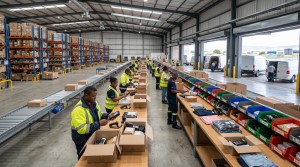
Automation at Scale: Fastway's Johannesburg hub processes up to 6,000 parcels per hour using automated sorting and routing technology, demonstrating how investment in throughput capacity enables distribution operators to absorb volume growth without compromising reliability. (Source: BizCommunity, 2026)
The first shift is automation: manual parcel processing simply cannot scale at the required pace. Operators who invest in automated sorting hubs and route optimisation tools will be the ones handling the 2026–2028 volume surge reliably. The second is system integration — SME retailers need API and direct data connections to courier networks so that quoting, labelling, and tracking happen within their own systems rather than as manual add-ons. Operators who build these integrations will capture the growing SME e-commerce segment.
Third is efficiency-driven cost reduction: the operators who thrive will be those who use route optimisation and load consolidation to keep per-parcel costs competitive as fuel and labour costs rise. Fourth, higher-value parcel protection is becoming a commercial differentiator — extended liability cover and secure handling for electronics and premium consumer goods can justify price premiums and build merchant loyalty. Fifth, real-time transparency is now a baseline expectation: WhatsApp, SMS, and email tracking updates are not a premium feature but a minimum requirement for consumer trust in online transactions.
Two structural constraints unique to South Africa and the broader SADC region complicate the last-mile picture. Security remains a significant cost item: GPS tracking, driver identity verification, and secure delivery protocols add operational complexity that operators in other markets do not face at the same scale. Load shedding has delayed EV fleet adoption, with operators unable to guarantee overnight charging reliability without off-grid infrastructure investment.
For operators serving the broader SADC region, the opportunity is significant but requires tailored approaches. Informal address systems, patchy road infrastructure outside urban cores, and varying regulatory frameworks across Namibia, Botswana, Zimbabwe, and Zambia mean that the South African last-mile model cannot simply be replicated across borders without adaptation. Operators who invest in local partner networks and address intelligence tools will be best positioned to capture cross-border e-commerce distribution growth.
The R100 billion e-commerce milestone creates a major demand signal for last-mile distribution infrastructure across Southern Africa. Freight and courier operators who invest in automation, merchant system integration, and real-time tracking now will be in the strongest position to capture the next phase of volume growth — both in South Africa and across the wider SADC market.
Stay connected with Southern Africa's freight and transport community.
Join 6,400+ logistics professionals across the SADC region.
Visit Laaimylorrie.com| About the Author | |

|
Andre Klynsmith Entrepreneur & Technology Enthusiast Andre's expertise spans technology, blockchain, transport, and logistics -- with a passion for innovation and driving positive change across industries. |
| Source: BizCommunity View source › | 2026 |


Subscribe to our Newsletter and stay in the know with all the latest Industry News, Products and Trends covering the whole of the SADC region.
KS Blockchain T/A Laaimylorrie.com . All Rights Reserved.