Industry related headlines to keep you in the know.

Africa’s mining resurgence is colliding with deep infrastructure and logistics constraints that shape everything from costs to competitiveness.
Africa is entering a new era of mineral demand as global industries accelerate their shift to clean energy, increasing the strategic importance of copper, cobalt, lithium, and other critical resources mined across the continent. But even as countries launch national strategies and the African Union pushes for value-chain development, the region’s logistics backbone remains under immense strain.
From long, unpredictable road routes to limited rail capacity, high transport costs, and congested ports, the ability to move minerals efficiently is increasingly determining the success or failure of mining operations.
Mining remains a major contributor to several African economies. In South Africa, mining sales value rose to R865.8 billion (about $49.95 billion) in 2024, up 9% year-on-year. According to South Africa’s Department of Mineral and Petroleum Resources (DMPR), the sector contributed 6.1% to the country’s nominal GDP.
Africa is reorienting its resource agenda toward the minerals essential for the global clean-energy transition. A continental framework produced by the African Union, the African Green Minerals Strategy, is taking shape to accelerate the growth of strategic mineral value chains while also addressing energy shortfalls.
In parallel, individual nations are rolling out their own policies and roadmaps. Zambia launched its critical minerals strategy in August 2024, and South Africa followed in May 2025.
The African Union’s African Minerals Development Centre notes that mineral supply chains are attracting increasing attention, and that access to raw materials has become a matter of strategic importance. The continent’s renewable energy potential—hydro, solar, and wind—also presents opportunities for Equitable Resource Based Industrialisation (ERBI).
Africa is rich in minerals essential for renewable energy technologies. However, BDO’s Annual Mining Report 2025 highlights several challenges faced by the mining industry, including unreliable electricity grids, environmental and social risks, complex tax regimes, inadequate transport infrastructure, and high logistics costs.
A large share of African raw minerals is exported to China, Europe, and other processing hubs. Trade data consistently shows China as a key destination for many mineral exports. According to the World Integrated Trade Solution, in 2023 the top partner countries for Sub-Saharan Africa’s mineral exports included China, Mozambique, France, the Netherlands, and India.
Guinea’s exports of bauxite, a feedstock for aluminium, increased 36% to a record 99.8 million tonnes in the first half of 2025, driven by strong Chinese demand, even after earlier declines linked to a regulatory crackdown.
Zack Hartwanger of Open Mineral noted that most materials still move by road to coastal ports, creating persistent bottlenecks, long border delays, cross-country transit challenges, and congestion at ports.
President Cyril Ramaphosa’s recent signing of the Public Procurement Bill into law represents a milestone for South Africa’s supply chain industry and broader economy. Read More >>>
Logistics is the connective tissue of mining, spanning road haulage, rail, inland terminals, conveyors, ports, stockyards, and shipping. While national plans and private investment are expanding capacity at mines, rail links, and ports, the gap between demand and infrastructure remains significant.
In August 2025, South Africa’s Ministry of Transport announced eleven private operators (out of 25) that were pre-selected to access 41 routes and six key rail corridors. These corridors cover transport for both bulk and containerised freight, including coal, iron ore, chromium, manganese, sugar, and fuel.
Transport consultancy ALG Global explained that these operators will sign access agreements with Transnet, allowing them to operate trains on allocated slots for periods ranging from one to ten years. Among them are logistics firms such as Grindrod and mining groups such as Menar, seeking to secure transport capacity for their production.
Hartwanger added that a major share of the world’s critical minerals originates in the Central African region, with cobalt and copper produced in the DRC and Zambia accounting for a significant portion of global supply. Yet, the continued reliance on road transport to reach coastal ports creates delays and congestion across borders and at terminals.
Speaking from the perspective of a large exporter, Alex Pickard of Ivanhoe Mines highlighted the scale of mining output in the DRC. Ivanhoe’s Kamoa-Kakula copper mine produces more than 0.5 million tonnes of copper at steady state, alongside over one million tonnes of concentrate. The company’s Kipushi operation is expected to deliver around 0.3 million tonnes of zinc, making it Africa’s largest zinc mine.
Pickard said logistics is the single most expensive part of running a mining business across the Central African copperbelt. At Kamoa-Kakula, logistics accounts for roughly one-third of operating costs. At Kipushi, where zinc is less valuable than copper, logistics can represent about half of total operating costs. Current options often involve long-haul trucking to Durban (about 3,000 km away) or Dar es Salaam (roughly 2,500 km by road).
Sphamandla Dlamini, Group Commercial Executive of Oketsa Group, described Africa as a “commodity-extraction-based minerals bulk continent,” where the sheer volume of ore and concentrate moving from pit to plant to port makes logistics a decisive factor in competitiveness.
Dlamini argued that rail is ultimately the long-term solution for African mining logistics, as only a continent-wide rail backbone can handle the bulk volumes required for minerals such as copper, cobalt, manganese, and iron ore. However, he noted that strengthening rail is a long-term project, describing it as a “50-year projection.”
This gap between infrastructure needs and near-term reality explains why mines remain dependent on road transport, often running thousands of kilometres across borders to reach depots, processors, and ports. Road logistics has scaled up despite inconsistent highways, limited border capacity, and fragmented regulations. Yet, the vastness of the continent and limited integration makes planning difficult, driving some of the highest logistics costs globally.
Ivanhoe Mines sees the Lobito Corridor as a direct response to the cost, reliability, and sustainability challenges defining copperbelt logistics today.
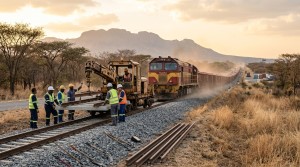
The Lobito Corridor is a multinational rail-and-port development linking Angola, the DRC, and Zambia. The project aims to create a shorter, more efficient export route from the copperbelt to the Atlantic Ocean, reducing transport distance, lowering logistics costs, cutting emissions, and shifting bulk mineral exports away from long, congested road routes toward modern rail infrastructure.
By shifting exports from long-distance trucking to a shorter rail route, the corridor could improve predictability and significantly reduce emissions tied to moving copper and zinc out of the DRC. For producers supplying metals central to global electrification, reliance on thousands of kilometres of diesel trucking undermines climate goals, making rail an important alternative.
Pickard noted that halving transport distance is only part of the opportunity. Rail is inherently more efficient than road freight, with fewer delays and better reliability. He added that trucking concentrate across 2,500 km is currently the single largest source of emissions in Ivanhoe’s value chain, and that rail provides an opportunity to reduce the emissions footprint across the mining sector in the DRC and neighbouring countries.
Africa’s mineral wealth is vast and its role in the global energy transition continues to grow, but logistics limitations remain a defining challenge. Rail revival will take decades, and road transport cannot sustainably carry the burden alone.
The future of African mining—and its ability to capture more value from critical minerals—depends on whether projects like the Lobito Corridor and broader infrastructure reforms can unlock faster, cheaper, and cleaner pathways from pit to port. Without this, the continent’s mineral opportunity risks being constrained by the very system meant to move it.

Laaimylorrie.com has made significant strides in revolutionizing the logistics industry with their advanced Freight Management System. Read More >>>

We’re thrilled to announce that Laaimylorrie.com has started the new year with a massive platform upgrade. Read More >>>

We are excited to share some updates and improvements to the payment system on Laaimylorrie.com. Read More >>>
Andre Klynsmith is a dynamic entrepreneur and technology enthusiast, with a fervent passion for innovation and its potential to revolutionize industries.
His expertise lies in the realms of technology, blockchain, transport, and logistics, where he consistently demonstrates his visionary thinking and dedication to driving positive change..

Contact me at info@laaimylorrie.com
Visit me at Laaimylorrie.com
Source: External Source - Click Here >>>
November 26, 2025


Subscribe to our Newsletter and stay in the know with all the latest Industry News, Products and Trends covering the whole of the SADC region.
KS Blockchain T/A Laaimylorrie.com . All Rights Reserved.